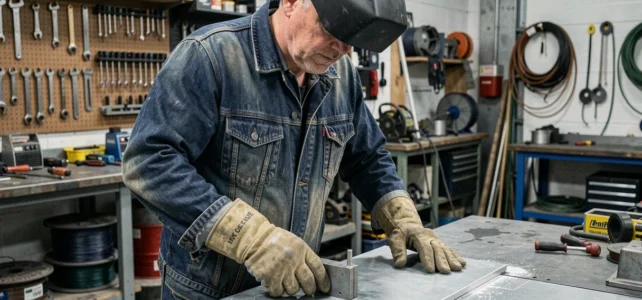
MIG welding aluminum is relatively accessible. Switching to aluminum with the same machine is another matter. The wire gets stuck in the liner, the molten pool either flows through the piece or doesn’t penetrate at all, and the bead looks like a string of droplets. Welding aluminum with a MIG machine presents specific challenges related to the properties of the metal, and solving them requires understanding what is really happening under the arc.
Oxide layer and thermal conductivity: the two traps of MIG aluminum welding
Aluminum naturally forms a thin oxide film on its surface. This layer melts at a much higher temperature than the metal itself. If you start the arc without removing it, the weld does not penetrate properly. The molten pool remains on the surface, trapped under an invisible crust.
A mechanical brushing with a stainless steel brush (reserved exclusively for aluminum) just before welding removes this layer. Wait more than a few minutes, and the oxide reforms. Brush the aluminum in the minutes leading up to the arc, not the day before.
The other difficulty is thermal conductivity. Aluminum dissipates heat very quickly. On a thick piece, the molten pool takes time to form because the heat escapes into the mass. On a thin sheet, it’s the opposite: heat accumulates locally and burns through the metal. For those looking to master aluminum welding with a MIG machine, understanding this thermal behavior changes the approach to each assembly.
MIG machine settings for aluminum: wire, gas, and feed speed
You may have noticed that aluminum wire gets stuck in the liner much more often than steel wire? That’s normal. Aluminum is soft and deforms easily under the pressure of the drive rollers. Three points deserve special attention.
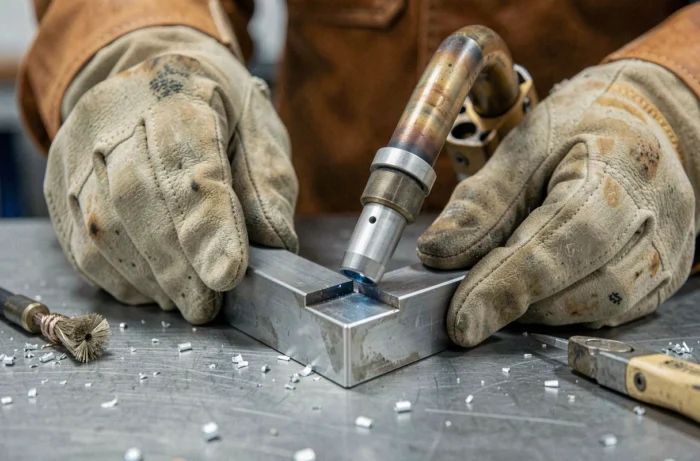
- The Teflon wire guide liner replaces the standard spiral steel liner. Aluminum wire does not slide well in steel and forms microscopic bends that cause jams. A Teflon liner significantly reduces these blockages.
- U-groove drive rollers (not V-groove) prevent crushing the wire. V-groove rollers deform aluminum wire and cause jams. Set the drive pressure to the minimum necessary for the wire to advance without slipping.
- The shielding gas must be pure argon. The argon-CO2 mix used for steel causes massive porosity on aluminum. Pure argon at a steady flow, without CO2 mix, is the only viable option for MIG aluminum.
The wire feed speed determines the stability of the arc. If it’s too slow, the arc goes out and the wire sticks in the pool. If it’s too fast, the wire pushes the pool and sprays droplets. The right setting produces a consistent sizzling sound, similar to frying, without jerks or dry pops.
Pulsed MIG on aluminum: why welds change in quality
Classic MIG machines send a continuous current. The molten pool receives a constant heat input, which is difficult to control on aluminum. In recent years, pulsed and double-pulsed MIG processes have gained traction, including on semi-professional machines.
The principle: the current alternates rapidly between a high peak (which detaches a droplet of wire) and a low level (which maintains the arc without overheating the piece). Pulsed MIG significantly reduces porosity and distortion compared to traditional globular transfer. On 6xxx series alloys, used in automotive and construction, documented industrial work in 2023 confirms this improvement.
For an amateur or semi-professional welder, pulsed MIG offers a concrete advantage: tolerance to speed errors increases. The pool remains more stable, spatter decreases, and the final bead is more uniform. The extra cost of the machine is justified as soon as you regularly weld aluminum.
Movement technique and management of the aluminum molten pool
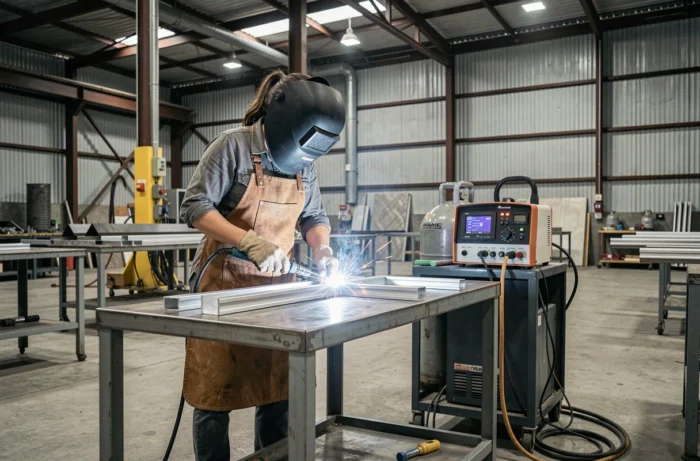
In steel MIG welding, you push or pull the torch according to your habits. On aluminum, the pushing technique yields better results in most cases. Pushing the torch allows the shielding gas to cover the area in front of the pool, where the metal is still hot and vulnerable to oxidation.
The travel speed must be faster than on steel. Aluminum heats up quickly, and slow movement accumulates too much heat. The bead widens, penetration becomes excessive on thin sections, and the risk of burning through increases.
Why do some beads have porosity in a string? Hydrogen is the main culprit. It comes from moisture, residual grease, or insufficient gas flow. Cleaning with acetone before brushing, combined with sufficient argon flow without excess (too high a flow creates turbulence that draws in ambient air), significantly limits these defects.
Respiratory protection: an underestimated risk in aluminum welding
Welding fumes from aluminum are not limited to classic metallic particles. Recent toxicological syntheses highlight a systemic inflammatory response caused by these fumes, with cytokine production and disruption of innate respiratory immunity. This phenomenon increases vulnerability to respiratory infections, an aspect largely absent from usual practical guides.
A powered air-purifying respirator with a P3 filter offers significantly better protection than a simple FFP2 mask. In a closed workshop, source extraction (an extraction arm positioned near the arc) remains the most effective measure. Welding aluminum in MIG indoors without extraction is like breathing a cocktail of metallic nanoparticles for the entire duration of the work.
The quality of a MIG aluminum weld relies less on the technique than on the preparation: surface cleaned at the right time, Teflon liner in good condition, suitable rollers, pure argon at the correct flow. A clean and strong bead is the result of ten technical details adjusted even before pulling the trigger.