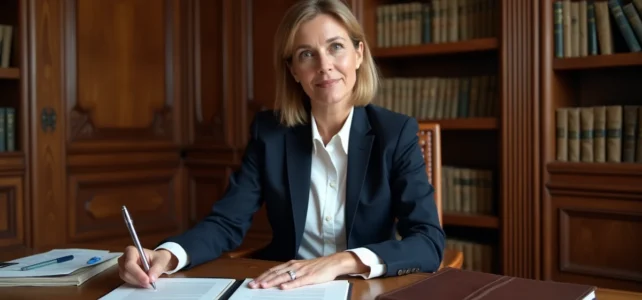
The word “notary” refers to a public officer responsible for authenticating legal acts. In French, this term belongs to the category of epicene nouns: its form remains the same for both masculine and feminine. Only the determiner changes. We write “un notaire” for a man, “une notaire” for a woman.
Epicene notary: what French grammar says
An epicene noun retains the same ending regardless of the gender of the person designated. The word “notary” functions exactly like “journalist,” “manager,” or “architect.” No morphological transformation occurs in the feminine form.
The grammatical gender is marked by the article (“le” or “la,” “un” or “une”) and by the agreements of the adjectives or participles that accompany the noun. Thus, we say “la notaire compétente” or “le notaire compétent,” depending on the person concerned.
This grammatical mechanism poses no technical difficulty. The question that often arises when trying to say a female or male notary is more about social usage than the linguistic rule itself. Grammar clearly states: both forms are correct.

Report of the Académie française on the feminization of job titles
The report of March 1, 2019, from the Académie française marks a turning point. The institution, long reluctant to the feminization of professional titles, explicitly recognizes that job titles can be used in the feminine when the language allows it naturally.
For epicene nouns like “notary,” the Académie confirms that the feminine is formed by simply changing the determiner. The Dictionary of the Académie française, in its 9th online edition, now mentions that “notary” can also be used in the feminine form.
Why this report matters
The Académie française does not legislate on the language: it observes and records usage. Its 2019 report ended an ambiguity that had lasted for several decades. Before this date, some speakers hesitated to write “une notaire” for fear of violating a grammatical norm. The report unequivocally removes this hesitation.
The TERMIUM Plus writing guide, a Canadian terminological reference tool, also classifies “notary” among epicene nouns. The example “une notaire” appears alongside “une gestionnaire” or “une journaliste,” confirming the convergence of Francophone norms on this point.
Master or mistress: the polite form for a notary
The professional title of the notary is “Maître,” abbreviated as “Me.” This title applies equally to men and women practicing this profession. One addresses a female notary by calling her “Maître,” not “Maîtresse.”
The confusion arises from the fact that “maîtresse” exists as the feminine of “maître” in everyday language (schoolmaster / schoolmistress). In the legal context, the title “Maître” remains invariant regardless of the person’s gender.
Forms of address in a letter or email
Writing a letter addressed to a notary follows precise conventions:
- At the beginning of a letter or email, write “Chère Maître” for a female notary or “Cher Maître” for a male notary
- In the final salutations, use “Maître” as is, for example: “Veuillez agréer, Maître, l’expression de mes salutations distinguées”
- On the envelope or in the recipient field, indicate “Maître” followed by the name, without mentioning “Madame” or “Monsieur” as a prefix
These conventions also apply to notary clerks when they hold the title of Maître, which depends on their exact status within the office.

Notairesse: a term to avoid in professional writing
The word “notairesse” exists in some historical dictionaries. It formerly referred to the wife of a notary, not a woman practicing the profession. This distinction is fundamental.
The Wiktionary lists the term and confirms its outdated nature. The Usito dictionary, a Quebec reference, also mentions it as archaic. No Francophone institution recommends “notairesse” to designate a female notary.
Using “notairesse” in a professional letter or legal document would be perceived as a mistake, even as a lack of consideration. The correct term remains “notary,” preceded by the feminine article when the situation requires it.
Feminization of legal professions: where is the usage
The notarial profession today has a growing proportion of women. This sociological evolution accelerates the normalization of the feminine “une notaire” in everyday language as well as in official texts.
Related legal professions have experienced similar paths. “Avocate” has been adopted without difficulty because the word has a morphologically distinct feminine form. For epicene nouns like “notary” or “judge,” the transition has been slower, as it relies solely on the change of determiner, which is less visible in spoken language.
- “Judge” functions like “notary”: we say “une juge” without transforming the word
- “Avocate” takes a marked feminine ending, which has facilitated its adoption
- “Clerk” follows the classic model of feminization by adding the suffix “-ière”
- “Huissière” or “huissière de justice” tends to gradually replace “huissier” in the feminine, although usage still hesitates
The general trend is towards the systematic adoption of the feminine for all job titles. The resistances, when they persist, are more a matter of habit than a real grammatical obstacle.
French grammar has all the necessary tools to correctly name a female notary. Writing “une notaire” or “la notaire” is grammatically correct, institutionally validated, and socially expected. The only real trap remains “notairesse,” which should be reserved for discussions about the history of the language.