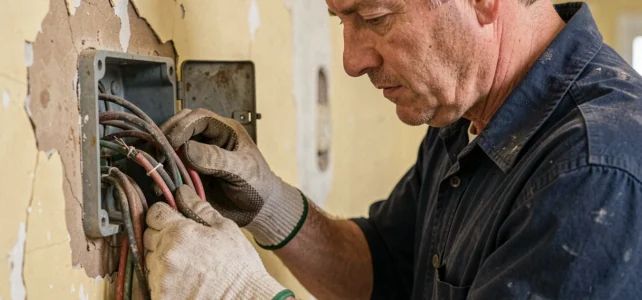
We open a junction box in a 1960s apartment and find three black wires, one red, and one gray. No sign of green-yellow, no blue. Before 1970, the color code for electrical conductors in France did not follow the same rules as today, and the combinations varied from one electrician to another. Understanding the old color code for electrical wires is an essential step before any work on an old circuit.
Identifying pre-1970 wiring without opening the walls
On site, the first clue is not the color but the texture. Cotton bitumen sheaths, hardened rubber, or lead immediately indicate an installation predating the 1970s. The soft and shiny PVC we know today did not yet exist in this form.
When you gently pull on the insulation and it crumbles or cracks, you are dealing with aged natural rubber. This material loses its insulating properties over time, which poses a real risk of short circuit.
The absence of a green-yellow wire in a junction box is another strong signal. Before the widespread adoption of the NF C 15-100 standard, grounding was not systematically installed in homes. It is common to find outlets without a protective conductor, especially in Haussmannian buildings and houses built between 1945 and 1970.
To better understand the old color code for electrical wires, it is important to remember that the current coding (blue for neutral, green-yellow for ground) only became standard from 1970.
Old color code for electrical wires: concrete correspondences
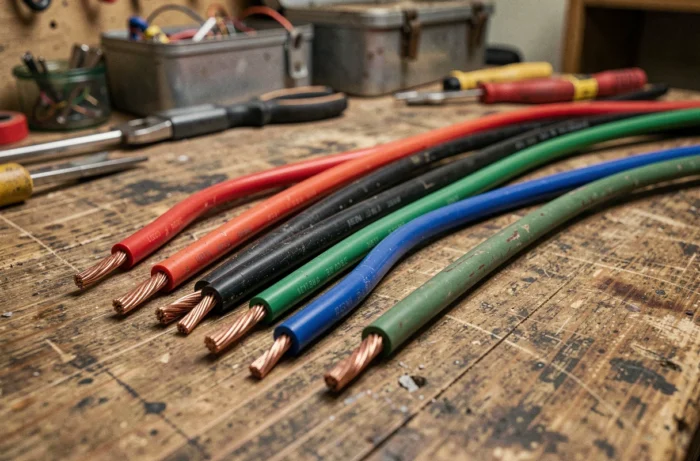
Before 1970, the phase could be red, black, brown, or even gray. The neutral was often black or gray, sometimes light blue. The ground, when it existed, was gray, red, or simply uninsulated bare wire.
The problem is obvious: a black wire could be neutral or phase depending on the installation. This is why one can never rely solely on color in an old home.
Typical correspondences before and after 1970
| Function | Colors before 1970 | Current color (NF C 15-100 standard) |
|---|---|---|
| Phase | Red, black, brown, gray | Red, brown, black (any color except blue and green-yellow) |
| Neutral | Black, gray, light blue | Blue |
| Ground | Gray, red, bare wire (or absent) | Green-yellow |
This table provides a trend, not a certainty. Feedback varies on this point, as some electricians of the time used their own local conventions. Only a multimeter test can confirm the function of each conductor.
Testing an old wire with a multimeter: field method
Set the multimeter to AC voltage mode, 250 V range or higher. Place one probe on the wire to identify and the other on a known ground (metal piping connected to the ground, for example).
- If the device shows a voltage close to 230 V, the tested wire is the phase.
- If the voltage is zero or very low (a few volts), it is the neutral.
- If no voltage appears between the wire and an identified phase conductor, you are likely dealing with the ground conductor.
Before touching anything, turn off the power at the main circuit breaker and check for the absence of voltage with a VAT (voltage absence tester). Never rely on the position of a switch in an old installation, as circuits may be crossed or doubled unexpectedly.

Partial or complete renovation: what the standard requires in 2025
The NF C 15-100 standard was profoundly restructured in August 2024, replaced by a series of 21 texts (NF C 15-100-X) each covering a specific scope. Since September 1, 2025, this new series is the only reference for new installations and major renovations.
A point often misunderstood: old wiring is not retroactively illegal. Portions of old circuits can be retained if their condition allows. However, as soon as a complete renovation is undertaken, all conductors must comply with the current identification.
Coexistence of old and new wiring
In practice, one often finds a new panel supplying partially old circuits. The main risk is confusion between an “old neutral” black wire and a “new phase” black wire.
- Label each old conductor with standardized colored tape (blue for identified neutral, green-yellow for ground).
- Document the identification on a diagram fixed in the electrical panel.
- Prioritize replacing sections with degraded insulation (cracked rubber, frayed cotton).
- Have the entire system checked by an electrical diagnostic if the home is intended for sale or rental.
An electrical diagnostic is mandatory for any home over 15 years old being sold or rented. This check identifies anomalies related to old wiring and provides a clear basis for prioritizing work.
Faced with a junction box filled with gray and black wires without identification, the temptation to connect “by feel” is real. This is exactly the action that causes an insulation fault or a return of current to the ground. Taking the time to test each conductor, label, document: in an old installation, these steps replace the color that the standard had not yet imposed.