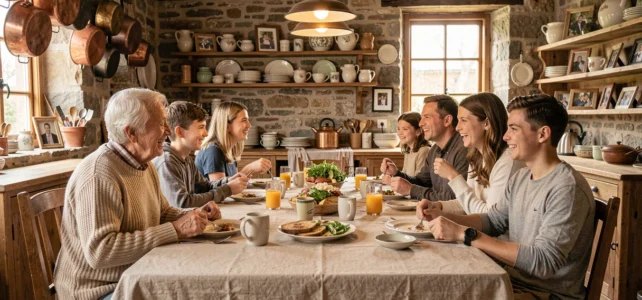
When you stumble upon a trunk of old photos in an attic or when a distant cousin sends a message on a social network, the same question arises: where does this family come from, and what connects it to others? Different families, whether royal, anonymous, or blended, carry stories that go far beyond mere anecdotes. Understanding these stories often means understanding a country, an era, a way of living together.
Digital Genealogy: When Teenagers Revive Family Research
Genealogy is still associated with departmental archives and patient retirees. In reality, things have changed on the ground. Events like the Genealogy Fair in Paris have seen a growing presence of children and teenagers in recent years, who are leading their parents in discovering family history.
In 2024, a 13-year-old boy created a “Genealogy Center” in the form of a Discord server. This is not an isolated case: younger generations are taking ownership of genealogy through online discussion and gaming platforms. Family adventures now take place through a screen, a headset, and collaborative databases.
This approach changes the very nature of exploration. One no longer consults a parish register alone in an archive room: family trees are compared collectively, discoveries are shared in real-time. To explore all families on Mr Seb, this logic of networking family stories can also be found, with each lineage referring to other branches.
DNA Tests and Family Stories: A Massive Practice Despite the French Ban
Family narratives are increasingly disrupted by genetics. So-called “recreational” DNA tests remain formally prohibited for the general public in France, as confirmed by the 2021 bioethics law, under penalty of a fine of 3,750 euros. The reality on the ground is quite different.
Estimates reported by the press indicate that between 100,000 and 150,000 saliva kits are sold in France each year. In total, between 1.5 and 2 million French people have already taken a test, often circumventing the ban through orders from abroad.
The consequences for families are tangible. Half-brothers are discovered, unexpected geographical origins are revealed, and sometimes secrets kept for decades come to light. The word “family” then takes on a very different meaning depending on whether one is talking about biological lineage or shared experiences.
Genetic Genealogy and Judicial Investigations
On the judicial side, France has opened the door to genetic genealogy in criminal investigations. However, the Constitutional Council has censored certain provisions regarding the judicial use of this technique, reminding that the cross-referencing of family DNA data raises proportionality issues. Opinions on this point vary among legal practitioners, between advances for victims and risks to privacy.
Historical Dynasties: What Famous Lineages Reveal About Family Structures
Exploring different families also means confronting great dynasties. The Ramessids in Egypt, the Medici in Florence, the Genghisids in Central Asia: each lineage illustrates a distinct way of building and transmitting power.
What strikes when comparing these families is the diversity of legitimization strategies:
- The Ramessids compensated for a fragile lineage by systematically associating themselves with the sun god Ra, fabricating their legitimacy through religion rather than blood.
- The Medici relied on patronage, marital alliances, and architecture (their “delizie” villas in Tuscany) to establish an influence that was not dynastic at the outset.
- The Genghisids entrusted women with an active political role in consolidating the empire, far from the reductive image of “yurt guardians.”
Each dynasty invented its own rules of transmission, and these rules tell as much about the era as they do about the family itself.
Blended Families and the Evolution of Law: The Legal Framework Redefining Parenthood
One cannot talk about the world of families without addressing the ongoing legal transformation. French family law is evolving at a rapid pace, and these changes directly alter what we mean by “family.”
Among recent developments, the Court of Cassation has opened a new path to recognize the parentage of children born through surrogacy abroad in France. The Civil Code has also seen the disappearance of the notion of “conjugal duty,” a change that redefines obligations within the couple.
What Law Changes in Family Stories
These developments are not abstract. They determine who can inherit, who appears on a birth certificate, who has parental authority. The law shapes the official contours of family, and when it shifts, family narratives shift with it.
For blended families, the question of proof in family law has also become more complex. The proportionality control applied to the burden of proof means that a judge can refuse certain evidence (private messages, digital data) if it disproportionately infringes on privacy. The digital age has made the boundary between family life and documented life particularly porous.
Family Activities to Explore History: Workshops, Exhibitions, and Fieldwork
Exploring family stories does not solely rely on archives or law. Concrete experiences allow for sharing this discovery across generations.
- Genealogy workshops for children are multiplying in libraries and at specialized fairs, with adapted materials (illustrated trees, chronological card games).
- Interactive exhibitions, such as those offered in science museums, allow younger audiences to experiment through manipulation and direct observation.
- Fieldwork remains the best trigger: visiting a village of origin, photographing an old grave, questioning a grandparent about their childhood memories.
Family history is better transmitted through experience than through a fixed narrative. An afternoon spent decoding a birth certificate with a ten-year-old anchors more than a lecture on genealogy.
Different families, whether famous or ordinary, share a common point: their stories only come to life when someone decides to seek them out. The nature of this search has changed, with digital tools, genetic tests, and legal evolutions, but the driving force remains the same—a curiosity about what precedes us and what connects us.