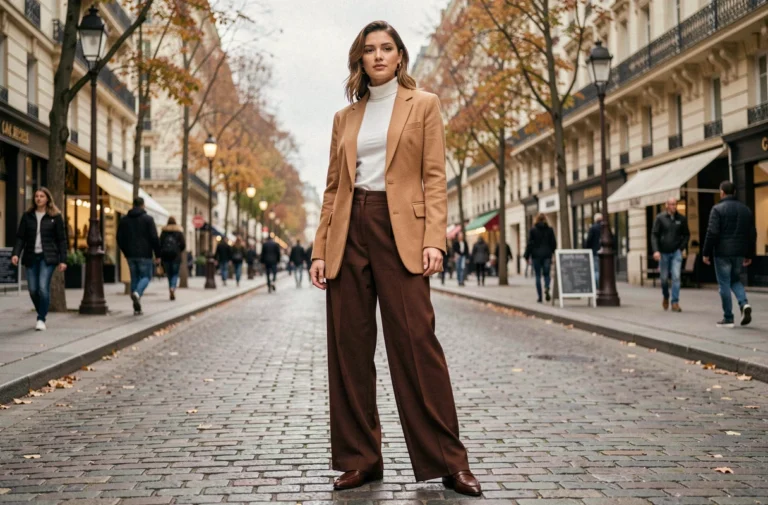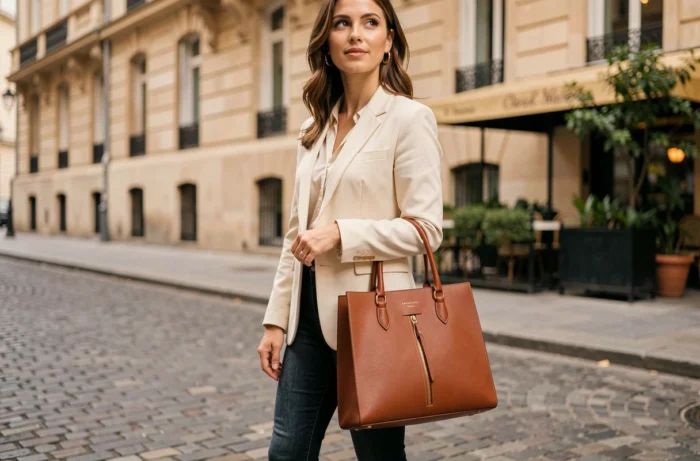
Choosing a bag for everyday use involves balancing three rarely aligned variables: shape, material, and carrying style. Finding the perfect bag to enhance your style requires measuring the gap between what you actually carry and what the bag’s silhouette visually communicates. This article compares these criteria to identify the most coherent combinations based on usage.
Usability and carrying comfort: the criteria that fashion guides overlook
Most guides direct the choice of a bag towards color or seasonal trends. However, the most structuring parameter remains the position of the center of gravity relative to the body. A bag carried far from the torso (like a large tote at the end of the arm, for example) shifts the center of gravity laterally, which puts more strain on the shoulder and back.
A short-adjustable crossbody bag, pressed against the hip, keeps this center of gravity close to the trunk. The width of the strap also plays a role: the narrower it is, the more pressure is concentrated on a small area of the shoulder.
For everyday use, crossing these two parameters (distance from the body and strap width) already provides an effective filter before even considering aesthetics. Additionally, Modenmarie.com’s fashion tips detail how to align these practical constraints with current trends.
Comparison of bag types based on daily use
The table below compares five common bag shapes, crossing their capacity, carrying style, and the stylistic register they most naturally associate with.
| Bag Type | Carrying Style | Capacity | Dominant Register | Ergonomic Constraint |
|---|---|---|---|---|
| Tote | Shoulder or hand | High | Casual, urban | Poor weight distribution if loaded |
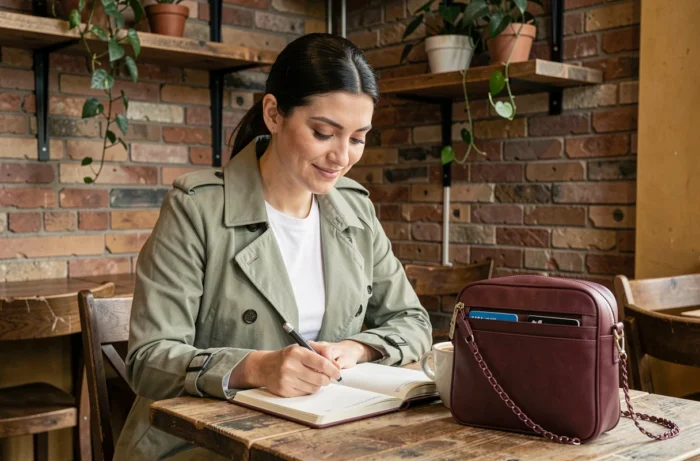
| Structured Crossbody | Adjustable crossbody | Medium | Versatile, semi-formal | Low if strap is wide |
| Clutch | Hand or under the arm | Low | Dressed up, evening | Occupies one hand at all times |
| Bucket Bag | Shoulder or crossbody | Medium to high | Casual chic | Low center of gravity, stable |
| Compact Backpack | Two shoulders | Medium | Urban, active | Symmetrical weight distribution |
Two discrepancies stand out. The tote, often presented as the default everyday bag, concentrates the load on one side of the body as soon as its contents exceed a certain threshold. In contrast, the compact backpack distributes weight across both shoulders, making it more suitable for long journeys, despite a stylistic register perceived as less formal.
The structured crossbody occupies an interesting middle ground. Its medium capacity is sufficient for a standard daily routine (phone, wallet, keys, notebook) and its crossbody carrying style frees up the hands without sacrificing silhouette.
Leather, canvas, synthetic: how material affects style and lifespan
The material of a bag determines two things simultaneously: the shape retention over time and the stylistic signal sent. Full-grain leather develops a patina, gains character over the years, and maintains its structure. A thick canvas material ages differently: it stretches, softens, and directs the silhouette towards a more casual register.
Synthetic materials offer a price advantage, but their durability often remains inferior. A faux leather bag that peels after a few months of use is neither economical nor eco-friendly in the medium term.
- Vegetable-tanned leather withstands daily wear well and can be easily repaired by a leather artisan, extending its lifespan by several years.
- Coated canvas (like waxed cotton) offers good water resistance for a reduced weight, a clear advantage for bike rides or rainy weather.
- Recycled nylon, found in technical ranges, combines lightness and strength, but its appearance is often difficult to integrate into a dressed-up register.
The choice of material also affects resale value. A well-maintained leather bag retains significant residual value in the second-hand market, a segment that is growing each year in France.
Digital product passport: a future selection criterion for bags
The European regulation on the eco-design of sustainable products (ESPR, EU regulation 2024/1781) introduces the concept of a digital product passport. This system aims to associate each textile item with information about its composition, durability, and traceability.
Textiles are among the priority categories of the European work plan 2025-2030. The specific obligations will depend on a future delegated act, but the direction is clear: transparency about the origin and durability of materials.
For choosing an everyday bag, this evolution will change the game in the long run. Comparing two models will no longer be limited to shape and price: a scan will suffice to know the type of tanning, the country of manufacture, and the estimated reparability of the product.

Body shape and silhouette: adapting bag size to your build
A bag that is too large on a slender silhouette overwhelms the proportions. Conversely, a small bag on a broad build can appear unbalanced. The basic principle remains proportionality.
- A slender silhouette benefits from carrying a small to medium-sized structured bag that does not fall below the hip.
- A broader build can visually accommodate a tote or bucket bag without losing harmony.
- The length of the strap alters the focal point: a bag positioned at the waist defines the silhouette, while a bag that falls mid-thigh visually elongates the torso.
This fine adjustment of carrying style has as much impact on style as the choice of the model itself. Two people carrying the same crossbody bag, one with a short strap and the other with a long strap, project two very different silhouettes.
The perfect bag to enhance your everyday style is not the one that follows the current trend. It is the one whose shape, material, and carrying style correspond to what you carry, your body shape, and the distance you travel each day. The digital passport will soon make these choices clearer by adding verifiable durability to the decision-making criteria.