
A virtual real estate tour relies on a collection of spherical photographs (360°) linked together by navigation points. The potential buyer moves from one room to another from their screen, without time constraints or physical movement. This technical foundation, widely spread, says nothing about how the journey is constructed or the order in which information reaches the visitor.
360° Journey Scripting: What Distinguishes a Guided Tour from Simple Free Navigation
Most virtual tours offer free exploration: the user clicks wherever they want, in any order they wish. The result resembles a catalog of rooms without a guiding thread.
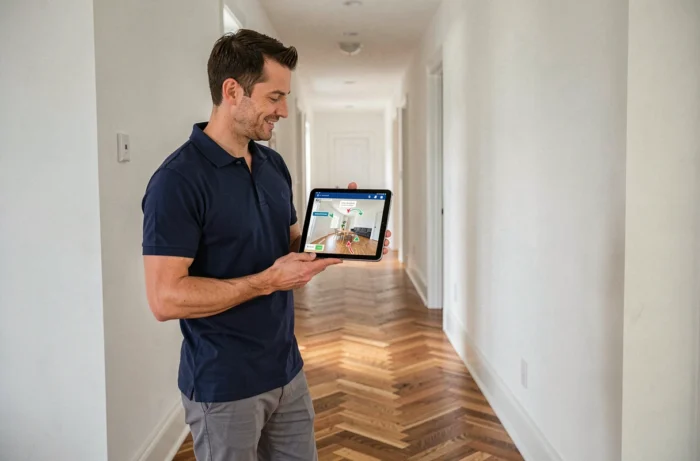
A scripted guided tour imposes a logical pathway. The entrance, living room, kitchen, bedrooms, and exterior follow an order designed to replicate the natural progression of a physical visit. Points of interest (hotspots) display contextual information at the right moment: area, materials, orientation, energy diagnosis.
The custom guided tour application Lamaison360 takes this logic further by allowing the journey to be adapted to each property. The agent or owner chooses the sequence of scenes, the commented stops, and the highlighted elements, transforming a series of photos into a real estate narrative.
This approach reduces the risk of the buyer leaving the tour after two random clicks in a poorly lit hallway. The visitor follows a story, not a mosaic of views.
Cost of Producing a Virtual Real Estate Tour in 2026
The price of a professional tour created with a Matterport-type scanner has significantly decreased in recent years. According to data compiled by Vizion Studio, the cost per square meter for a standard apartment in France has dropped from a range of €4.50 to €9 excluding VAT/m² in 2020 to about €2.50 to €4.50 excluding VAT/m² in 2026, representing a decrease of about 40 to 50% over five years.
This price drop changes the equation for agencies that were hesitant to standardize the tool. A T3 of 65 m² now costs between approximately €160 and €290 excluding VAT, which remains lower than the cost of a high-end professional photo shoot with retouching.
3D Scan or 360° Photography: Two Levels of Rendering
The 3D scan (Matterport, for example) generates a navigable three-dimensional model with a “dollhouse” view. Classic 360° photography, taken with a camera like the Ricoh Theta or the Insta360, produces spheres linked together without volumetric modeling.
- The 3D scan offers automatic surface measurement and deeper immersion but requires expensive equipment and longer post-production time.
- 360° photography is sufficient for most residential properties and lends itself better to quick scripting via a dedicated mobile application.
- Both formats can integrate informative hotspots (DPE, plans, descriptions), provided that the distribution platform allows it.
The choice depends on the type of property. For a new program in VEFA, 3D modeling in synthetic images is often preferable since the property does not yet physically exist. For an existing apartment or house, the scripted 360° photo offers the best balance between production cost and impact on the buyer.
GDPR and Virtual Tour Applications: Often Ignored Constraints
Any mobile application that collects usage data (time spent per room, visitor geolocation, navigation path) falls under the scope of the GDPR. The CNIL reminds us that a technical authorization granted by iOS or Android, such as access to the camera or geolocation, does not constitute consent in the sense of the European regulation.
Three specific obligations apply to publishers of real estate applications that track visitor behavior:
- The implementation of a CMP (Consent Management Platform) integrated into the application, distinct from the phone’s system permissions.
- The conduct of a data protection impact assessment (DPIA) as soon as usage tracking is done on a large scale.
- The logging of proof of consent: timestamp, version of the application, and exact text presented to the user at the time of acceptance.
This regulatory framework is rarely mentioned in comparisons of virtual tour tools. A real estate agent using an application that collects time spent per room without valid legal basis exposes themselves to a formal notice. The fact that the data is anonymized on the interface is not sufficient if the device identifier allows for cross-referencing.

Virtual Tour and Real Estate Listing: Impact on the Buyer Journey
Integrating a 360° tour into a listing modifies two steps of the acquisition journey. First, the initial sorting: a buyer who has already “visited” the property online will only visit in person if they are genuinely interested. Unnecessary physical visits decrease, freeing up time for both the agent and the seller.
Next, the negotiation. A buyer who has been able to examine each room, check the layout, and spot visible defects arrives with fewer surprises. Objections related to on-site discovery diminish, which smooths the discussion about price.
DPE and Technical Data in the Virtual Journey
Since the DPE reform, displaying the energy class in the listing is mandatory. Some platforms allow this diagnosis to be integrated directly into the virtual tour in the form of a clickable hotspot. The buyer accesses the energy letter, estimated consumption, and work recommendations without leaving the tour.
This contextual integration avoids the frequent disconnect between a listing that promises a bright property and a DPE rated F hidden at the bottom of the page. The visitor sees the living room, clicks on the energy icon, and immediately accesses the information.
The guided virtual tour does not replace the physical visit. It filters buyers upstream, reduces unnecessary trips, and provides a structured framework for presenting a property. The differentiating factor is not the 360° technology itself, now available at a reasonable cost, but the quality of the narrative constructed around the images.