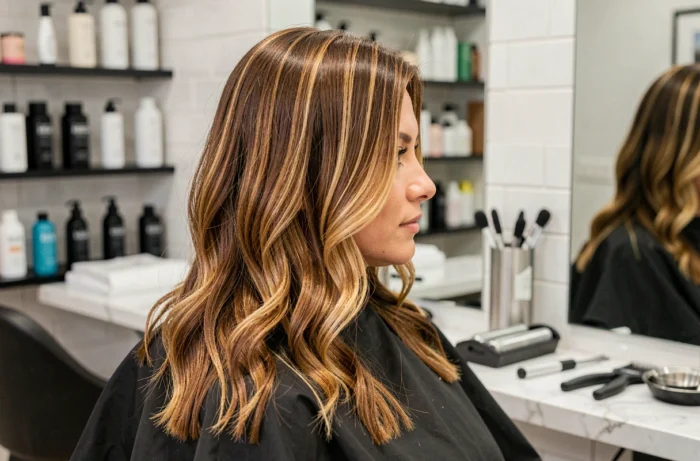
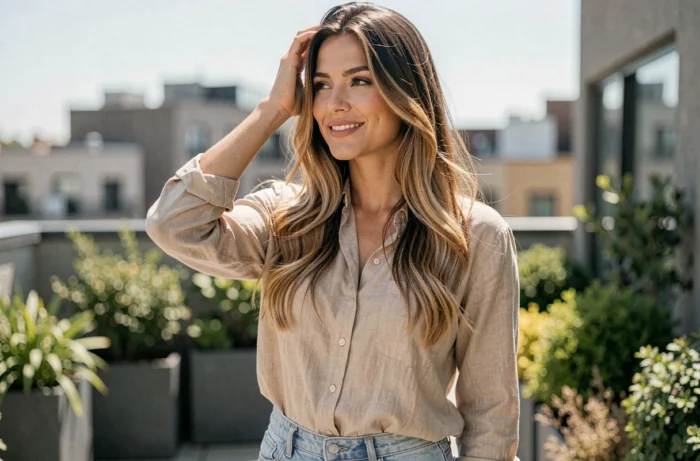
A dark blonde balayage on a brown base promises a bright and natural result. The question that conditions the entire process is not the final shade aimed for, but the actual state of the hair fiber before the first touch of lightening product. Coloring history, porosity, previous treatments: these parameters determine both the result and the level of damage sustained by the hair.
Targeted or global lightening: what the fiber really undergoes
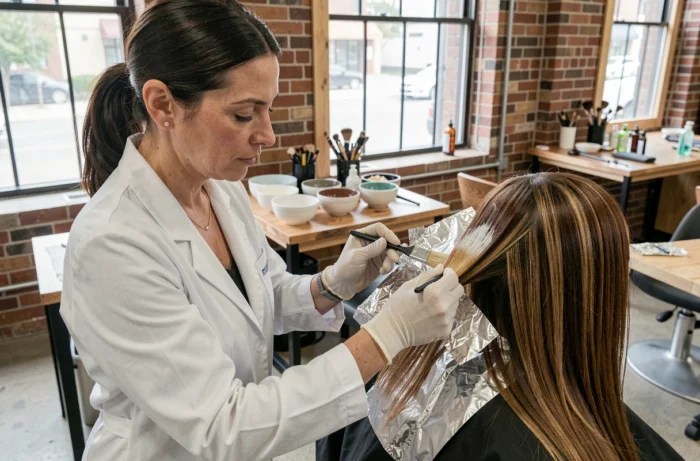
Balayage differs from full bleaching by the surface of hair exposed to the oxidizing product. While a complete coloring treats the entire head of hair, balayage only affects selected sections, without going up to the roots.
This difference in the treated surface has a direct impact on the chemical load endured. Bleaching results in a lasting loss of proteins and hydration on each strand affected, but the overall volume of weakened hair remains lower than that of full lightening.
| Criteria | Dark blonde balayage | Full bleaching |
|---|---|---|
| Treated surface | Targeted sections (lengths and ends) | Entire head of hair |
| Root contact | Limited or absent | Systematic |
| Overall chemical load | Lower | High |
| Touch-up frequency | Spaced out (blended effect) | Every few weeks |
| Main type of damage | Breakage on lightened areas | General weakening |
The main damage to watch for after a balayage is breakage of the fiber at mid-length, not shedding from the scalp. Thinning ends, small broken hairs visible around the crown: these signs indicate that the lightening has been pushed too far or poorly calibrated.
To better understand how far to lighten a dark brown base, a detailed guide on dark blonde balayage on brown hair helps to identify the technical limits depending on each situation.
Chemical history of the hair: the factor that the base color does not reveal
Two people with the same shade of brown can achieve radically different results. The reason lies in the chemical history of the hair, a parameter invisible to the naked eye.
An old home dye or a henna-based dye alters the hair’s reaction to the lightening product. Henna, for example, creates a sheath around the fiber that can cause coppery or greenish reflections during bleaching. A permanent dye applied a few months earlier leaves residual pigments that resist lightening and require a higher volume of oxidant.
The pre-balayage diagnosis must account for all operations performed, including those dating back several months. Here are the elements to report to the colorist:
- Any permanent or semi-permanent dye applied in the last twelve months, in a salon or at home
- The use of henna or plant-based dyes, even if it dates back more than a year (henna stays in the fiber for a long time)
- A Brazilian blowout, perm, or any recent structural chemical treatment
- Previous bleachings, even partial ones, that may have weakened certain areas
In the absence of this information, the colorist works blindly. The risk is not only aesthetic (shade turning reddish or orange): it is also a mechanical risk of breakage.
Dark blonde balayage on brown: calibrating the tone lift
On a brown base, achieving a dark blonde generally represents a lift of two to three tones. This is a moderate difference, which is why this type of balayage is often described as “gentle” on the fiber.
This reputation is partly justified. A two-tone difference requires a significantly shorter processing time and a lower volume of oxidant than what is necessary to achieve a polar blonde from the same base. The fiber therefore retains more structural proteins.
However, caution is advised on lengths that are already sensitized. The ends, being older and often more porous, absorb the product faster and lift in tone more quickly than the roots. An experienced colorist adjusts the processing time zone by zone to avoid overexposing the ends.
Golden, ash, or beige shades: the impact of the lightening base
When brown hair is lightened, it goes through orange bases before reaching yellow. To achieve a dark blonde with ash reflections, a corrective pigment (often blue-violet) neutralizes these warm undertones. For a golden or honey blonde, the colorist instead exploits this natural warm base.
The choice of final reflection conditions the type of toner applied after lightening. A poorly dosed toner can dull the color or give it a grayish appearance. The result depends as much on this correction step as on the bleaching itself.
Post-balayage maintenance: spacing out touch-ups without losing brightness
One of the measurable advantages of balayage compared to full coloring is the frequency of touch-ups. The blended effect, without a clear demarcation at the roots, allows for significantly spaced appointments compared to a classic root touch-up.
This slower rhythm mechanically reduces the cumulative chemical load on the hair over the months. Fewer salon visits mean less overlapping of product on the same areas.
Between two touch-ups, the priority is to compensate for the loss of hydration on the lightened strands. The treated areas become more porous and lose their moisture faster. A leave-in treatment applied to the lengths after each wash limits dryness and preserves the fiber’s flexibility.
- Use a sulfate-free shampoo to avoid stripping the toner pigments
- Apply a protein mask once a week on the lightened lengths
- Limit the use of flat irons or hair dryers at maximum temperature on treated strands
- Protect the hair from prolonged sun exposure, which oxidizes the reflections and accelerates yellowing
The dark blonde balayage on brown hair remains one of the least aggressive techniques for gaining brightness. The determining factor is neither the desired shade nor the chosen technique, but the transparency of the initial diagnosis. Hair with a properly assessed history withstands lightening much better than a fiber treated without prior evaluation.