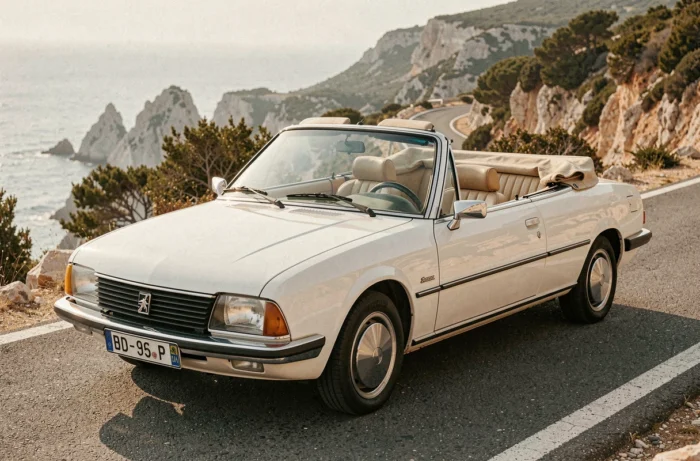
The Peugeot 305 convertible was never included in Peugeot’s official catalog. The range sold between 1977 and 1990 was limited to the sedan and the station wagon. Therefore, any convertible version branded 305 comes from a transformation by an independent coachbuilder or from a project that remained in prototype form. This distinction affects everything else: value, homologation, maintenance, insurability.
Chassis of the Peugeot 305 convertible: check the origin before any purchase
A convertible derived from the 305 is not a homologated model in series. Each example has its own story: roof cutting, body reinforcements, roll bar or not, torsional rigidity treatment. We recommend systematically checking three points before considering a purchase.
- The chassis number must correspond to an original 305, with a consistent type approval. Any inconsistency between the registration document and the current body complicates registration as a collector’s vehicle.
- The coachbuilder responsible for the transformation must be identifiable. Some French and Italian workshops documented conversions in the 1980s, with technical files available for the FFVE.
- The structural rigidity after roof cutting varies significantly from one example to another. Without appropriate chassis reinforcements, the chassis may show visible deformations at the door level after a few years of use.
On a handmade convertible, the absence of technical documentation from the coachbuilder makes administrative compliance much heavier. This is not a deal-breaker, but the budget and timeline change radically.
Those wishing to understand the advantages of the Peugeot 305 convertible benefit from cross-referencing these technical elements with the precise history of the targeted example.
Engine and petrol block of the Peugeot 305: what ages well
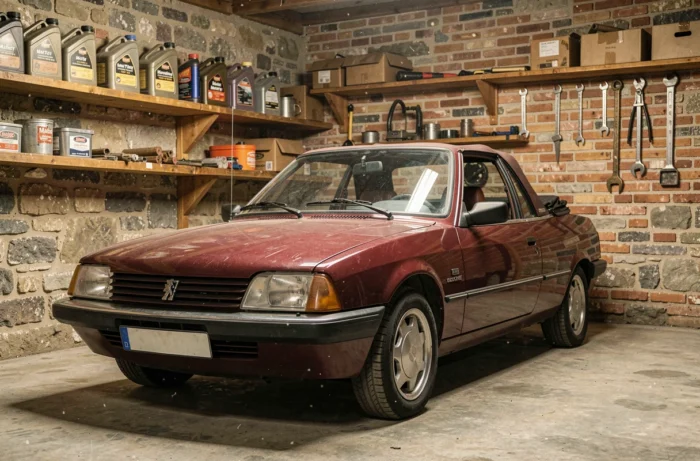
The 305 received several generations of petrol and diesel engines. On a convertible intended for leisure use, the XU block from series 2 remains the most relevant. Introduced from 1982, it offered better low-end torque than the older XL/XR engines from the first generation, and especially a reliability significantly superior to the first XUD diesels, which were known to be fragile on this base.
The 1.6 petrol in atmospheric version represents the most common compromise on surviving examples. Its timing belt requires regular replacement, but parts remain available through the network of vintage Peugeot specialists. The 1.9 petrol, rarer on the 305, provides superior enjoyment with the top down thanks to a wider operating range.
Gearbox and transmission
The five-speed manual gearbox fitted to the series 2 petrol versions handles the torque of these blocks well. However, on a transformed convertible, we sometimes observe parasitic vibrations related to the modification of the body rigidity. A worn transmission mount exacerbates the phenomenon. The diagnosis is simple, the replacement inexpensive, but it should be considered during the test drive.
Collector’s registration and regulations for a transformed 305
Since the eligibility threshold for collector’s registration has been set at thirty years, any Peugeot 305 produced before 1996 can theoretically qualify. In practice, convertible examples pose a specific problem: the body does not correspond to the original type approval.
The procedure goes through the FFVE, which issues a certificate after reviewing the file. For a transformed vehicle, proof must be provided that the modification is old (invoices, period photos, coachbuilder’s certificate). Without these elements, the certificate may be refused, and registration as a collector’s vehicle blocked.
The FFVE fees increased on October 1, 2026, slightly raising the administrative cost. Collector’s insurance, on the other hand, remains advantageous compared to standard insurance, provided that the limited usage criteria imposed by most contracts are respected.
Environmental constraints and ZFE
The collector’s registration exempts the vehicle from circulation restrictions in ZFE. This is a decisive argument for anyone wishing to drive in a French metropolis with a car from that era. Without this registration, a petrol 305 produced before 1997 is classified as Crit’Air 3 or higher, which prohibits access to an increasing number of city centers.

Value and market for the Peugeot 305: a window still open
The 305 sedan remains very affordable in the collector’s market. Prices have not followed the trajectory of models like the 205 GTI or certain Renault 5 Turbo, which have seen their values explode in recent years. A transformed convertible is in an even narrower niche: few examples are on the road, and few sales references exist.
This rarity works both ways. On one hand, the absence of an established value allows for reasonable purchases. On the other hand, resale can prove lengthy due to a lack of informed buyers. We observe that specialized shows and auctions are the most effective sales channels for this type of atypical vehicle.
The 305 is also experiencing a resurgence of interest due to its role as a technical laboratory at Peugeot. The VERA prototype, studied between 1980 and 1982, derived from aerodynamic research conducted around the 305 platform and significantly reduced the drag coefficient. This technical heritage, often overlooked, gives the 305 a legitimacy that its reputation as a discreet family car did not suggest.
Buying a 305 convertible today means betting on a rare, technically interesting, and administratively manageable object, provided that one does not overlook the chassis verification and transformation documentation. The market has not yet caught up with these atypical examples, and that is precisely what makes the acquisition window favorable.