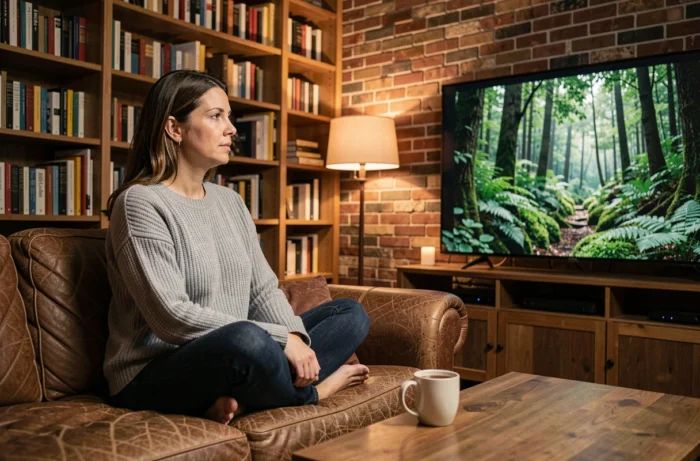
Documentary films and online reports are increasingly prominent in viewing habits. Where television imposed a fixed schedule, platforms allow for the selection of a subject, duration, and tone. This freedom has transformed the way the public accesses real-life narratives.
How online documentary funding has changed hands
For decades, French television channels financed the majority of documentary films. This model has cracked. By 2025, video-on-demand services increased their investments in French and European creation, while channels reduced theirs.
This shift has direct consequences on what you watch. Platforms favor projects with high audience potential, with budgets concentrated on fewer works. The result: more visually spectacular documentaries, but potentially less diversity in the genres offered.
Martin Ajdari, president of Arcom, highlighted this risk: platform funding tends to concentrate on a limited number of projects, with fewer hours filmed than with traditional channel funding. For fans of niche reports (nature, science, local history), this trend deserves attention.
Those who wish to discover Euromedia Television online will find a catalog focused on varied themes, far from the sole logic of massive audience appeal.
French regulatory obligations and online documentaries
France strengthened the decree related to audiovisual media services on demand at the end of 2025. A portion of mandatory investments must fund documentaries, animation, and live performances. This measure aims to prevent platforms from dedicating their entire budgets to fiction.

Wondering what this concretely changes? These obligations ensure that part of the online catalog offers documentary films produced in France, including on subjects that do not generate millions of views. Without this regulatory framework, only mainstream documentaries would survive on major platforms.
Free online reports: where to watch without a subscription
The availability of reports accessible without payment has significantly expanded. Several sources coexist, each with its own particularities.
- Replays from public channels (France Télévisions, ARTE) offer their documentaries for free access for a limited time after broadcast. ARTE highlights thematic documentary series covering history, science, and society.
- YouTube hosts specialized channels that broadcast complete documentaries in French, often grouped into thematic playlists (history, nature, sports).
- Specialized platforms like Tënk focus on auteur documentaries, with a reduced-price subscription model.
Free content dominates in volume, but paid content dominates in curation. Specialized platforms select their films with an editorial eye. YouTube channels offer quantity. The choice depends on what you are looking for: guided discovery or free exploration.
Nature, history, adventure documentaries: how to filter the overwhelming offer
The difficulty is no longer finding a documentary. It’s finding the right one. Between the catalogs of ARTE, France.tv, YouTube playlists, and dedicated platforms, the offer far exceeds what a viewer can browse.
Here are some pointers to refine your searches:
- By specific theme: online catalogs generally classify by genre (nature, science, history, society). Prefer integrated filters to free searches, which drown results in promotional content.
- By duration: a twenty-minute report and a two-hour documentary film do not offer the same depth. Short formats are suitable for a break; long documentary features require dedicated time.
- By director or producer: once a film has impressed you, searching for other works by the same director works better than algorithmic recommendations. The Film-documentaire.fr database allows searches by creator.

The recommendation algorithms of major platforms steer you towards content similar to what you have already seen. This functioning creates a thematic bubble. Varying sources remains the best way to discover unexpected topics.
What the rise of platforms changes for French documentaries
Online documentaries are experiencing a period of transition. Investments from platforms in French creation have significantly increased, but this rise does not automatically translate into more films produced. Budgets are concentrated on projects deemed promising.
For the viewer, this means more polished productions on popular subjects (adventure, animal life, major historical events) and a dwindling offer on less marketable niches. Documentaries about the planet, family, or daily life in lesser-known regions still find their place, but more on public channels and independent platforms than on streaming giants.
Auteur documentaries are migrating to specialized circuits while mainstream documentaries settle on generalist platforms. This separation redraws the map of online offerings. To not miss anything, combining two or three different sources remains the most reliable strategy.