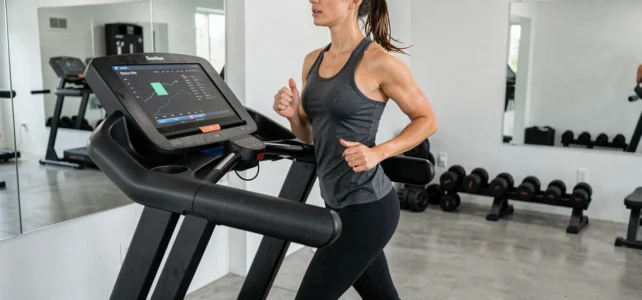
You plug in a new treadmill, launch three sessions in the first week, and everything seems perfect: smooth stride, responsive motor, relative silence. The real test of the Sportstech F37 begins after several months of regular use, when the motor has endured hundreds of kilometers and the belt has absorbed thousands of impacts. This is precisely the angle that most online tests overlook, focusing instead on unboxing and first impressions.
Durability of the Sportstech F37 after several months of daily use
The majority of available reviews focus on setup and the initial sessions. They mention that assembly is quick, the console powers on without a hitch, and running is enjoyable from the first kilometer. All of this is true.
The point that user feedback highlights is the behavior of the motor beyond the first few weeks. At a moderate pace, the mechanics remain reliable and consistent over time. However, feedback varies on this point when pushing regularly towards the highest speeds: some users report a motor that operates more audibly after several months of intensive training.
For those who want to learn more about the Sportstech F37, the detailed technical sheet allows you to check if the sizing matches your own training pace. This is a useful reflex before investing.
The F37 delivers on its promises for regular use at a moderate pace. For daily high-intensity sessions over the long term, you approach the limits of a home device in this price range.
Incline and running surface: what it really changes in training
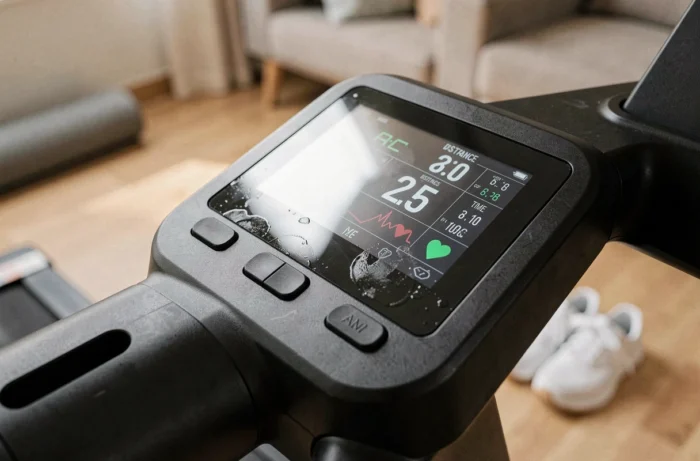
The electric incline of the F37 covers a range from 0 to 15%. In practice, going from 0 to 8% transforms a leisurely jogging session into a sustained cardio effort without changing the speed. This is a lever underutilized by many users who focus solely on km/h.
The running surface remains a compromise. It suits a short or medium stride, which covers the vast majority of home joggers. Taller runners (over one meter eighty) may feel constrained in their stride length, especially at high speeds.
- Up to 12-14 km/h, the belt offers satisfactory running comfort for most body types.
- Beyond that, taller runners must shorten their stride or risk stepping on the back edge of the treadmill.
- The incline partially compensates for this limit by increasing effort without requiring a longer stride.
The electric incline is the real training asset of the F37, more than the maximum speed displayed. Simulating realistic hills at home significantly changes the quality of sessions.
Sportstech F37 or F37s: clarifying the variants before buying
Recent product listings distinguish the original F37 from the F37s or F37s Pro variants. These references are often mixed in many comparisons, complicating the reading for a buyer.
The classic F37 features a basic LCD screen, heart rate sensors on the handlebars, and compatibility with training apps like Kinomap. The “s” and “s Pro” variants generally add a larger screen, sometimes touch-sensitive, and adjustments to connectivity or the cushioning system.
Checking the exact model reference before ordering avoids unpleasant surprises. The price can vary significantly between the base F37 and the Pro version, with differences mainly in interface and user comfort, not in the motor or mechanical structure.
Training programs and connectivity of the F37
The F37 offers 12 pre-recorded training programs. In practice, three or four are used regularly, with the others mainly serving to vary sessions occasionally. Bluetooth connectivity allows the device to connect to third-party apps, greatly expanding possibilities beyond the built-in programs.
The Kinomap app is not mandatory. You can perfectly use the treadmill in manual mode or with the built-in programs. Kinomap provides real interest for those who need visual stimulation or structured tracking over several weeks.
Noise level of the Sportstech F37: what to expect in an apartment
Noise is the criterion that comes up most often in user feedback, and it makes sense: a home treadmill often runs early in the morning or in the evening, sometimes above a neighbor.
At walking or light jogging speed, the F37 remains within an acceptable noise range for an apartment. The motor produces a steady hum, easily covered by the television or headphones.
At full speed, the level rises notably. The impacts of the stride add to the mechanical noise. An anti-vibration mat placed under the device reduces transmission to the ground, but does not eliminate airborne noise. For use in a building beyond 15 km/h, it’s better to inform neighbors or limit these sessions to reasonable hours.
Folding and space requirements in daily use
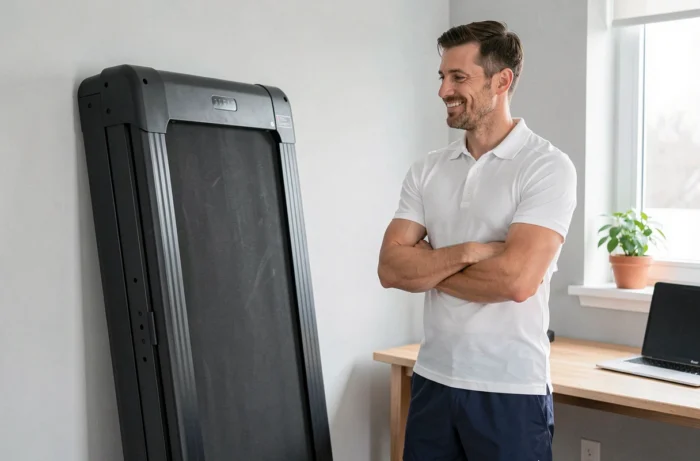
The hydraulic folding system works well. The piston prevents the treadmill from falling suddenly, which secures handling. Once folded, the device frees up floor space, but it remains bulky in height.
- The weight of the device makes moving it impractical despite the integrated wheels.
- Daily folding is realistic if you have an established routine, but you often end up leaving the treadmill unfolded.
- Planning for a semi-permanent location is more realistic than relying on regular folding.
The Sportstech F37 fulfills its promise for a home runner looking for a complete device without reaching the prices of premium brands. Its real strength lies in the incline and the value for money, not in the promise of unlimited intensive use. Choosing this treadmill with an understanding of its mechanical limits ensures you won’t be disappointed by the sixth month.