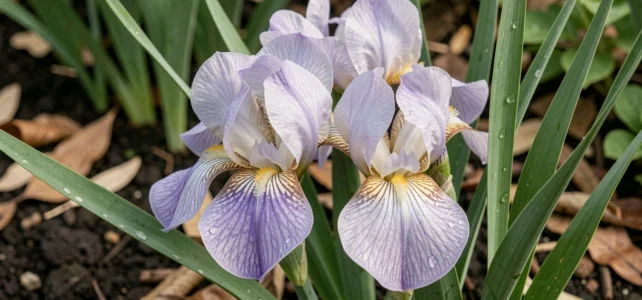
The walking iris (genus Neomarica, notably Neomarica northiana) has little in common with the bearded iris of dry beds. Its mode of vegetative expansion, tolerance to partial shade, and requirements for humus-rich soil make it a unique plant within the Iridaceae family. Here, we detail the technical points that truly determine its success in cultivation.
Vegetative expansion of the walking iris: understanding the colonization mechanism
The feature that gives this plant its name lies in its flower stalks. After flowering, the stem becomes heavy with a new seedling formed at the top, bends toward the ground, and roots at a distance from the mother plant. This process, repeated season after season, allows the clump to gradually move through the garden.
This mode of propagation clearly distinguishes Neomarica from classic rhizomatous irises, whose expansion remains concentric and slow. The walking iris actively colonizes space, making it a relevant choice for naturalizing a light woodland or stabilizing a cool area in tropical or subtropical conditions.
We recommend not systematically removing spent flower stalks: they are what ensure natural multiplication. If you wish to find complete profiles on walking irises on Jardinier.net, the cultivation of Neomarica is discussed alongside other garden perennials.
However, in a restricted space (pot, planter, veranda), this colonization dynamic must be controlled through repotting or regular division to prevent substrate suffocation.
Humus-rich soil and partial shade: the reversed requirements compared to the bearded iris
The majority of gardening guides dedicated to irises emphasize full sun and radical drainage. These recommendations do not apply to Neomarica. The walking iris thrives in cool, organic-rich soil, with consistent moisture without excess stagnant water.
An ideal substrate combines leaf mold, mature compost, and a fraction of perlite or pumice to maintain root aeration. A slightly acidic to neutral pH is perfectly suitable.
In terms of light, partial shade is not only tolerated but often preferred, especially indoors or in a Mediterranean climate. Filtered light, similar to that of a woodland, replicates the natural conditions of Neomarica northiana, which originates from Brazilian tropical forests. Prolonged direct sunlight in summer burns the foliage and reduces the flowering duration.
Quick comparison of requirements: walking iris vs bearded iris
| Criteria | Walking iris (Neomarica) | Bearded iris (Germanica) |
|---|---|---|
| Exposure | Partial shade to filtered light | Full sun essential |
| Soil | Humus-rich, cool, well-aerated | Draining, calcareous, dry on the surface |
| Rhizome | Buried, covered with substrate | Exposed, facing the sun |
| Hardiness | Low (frost-sensitive below a few degrees) | High (resistant to marked cold) |
This opposition explains why transplanting maintenance advice from a bearded iris to a walking iris almost always leads to failure.
Division and density management: the key factor for flowering
A walking iris that no longer flowers almost always suffers from excess density. The heart of the clump ages, the rhizomes become exhausted, and the plant concentrates its energy on foliage at the expense of flower stalks.
Division should occur after spring flowering, separating the vigorous peripheral clumps from the aging center. We observe that a division cycle every two to three years maintains regular flowering, while a visible decline occurs by the fourth year without intervention.
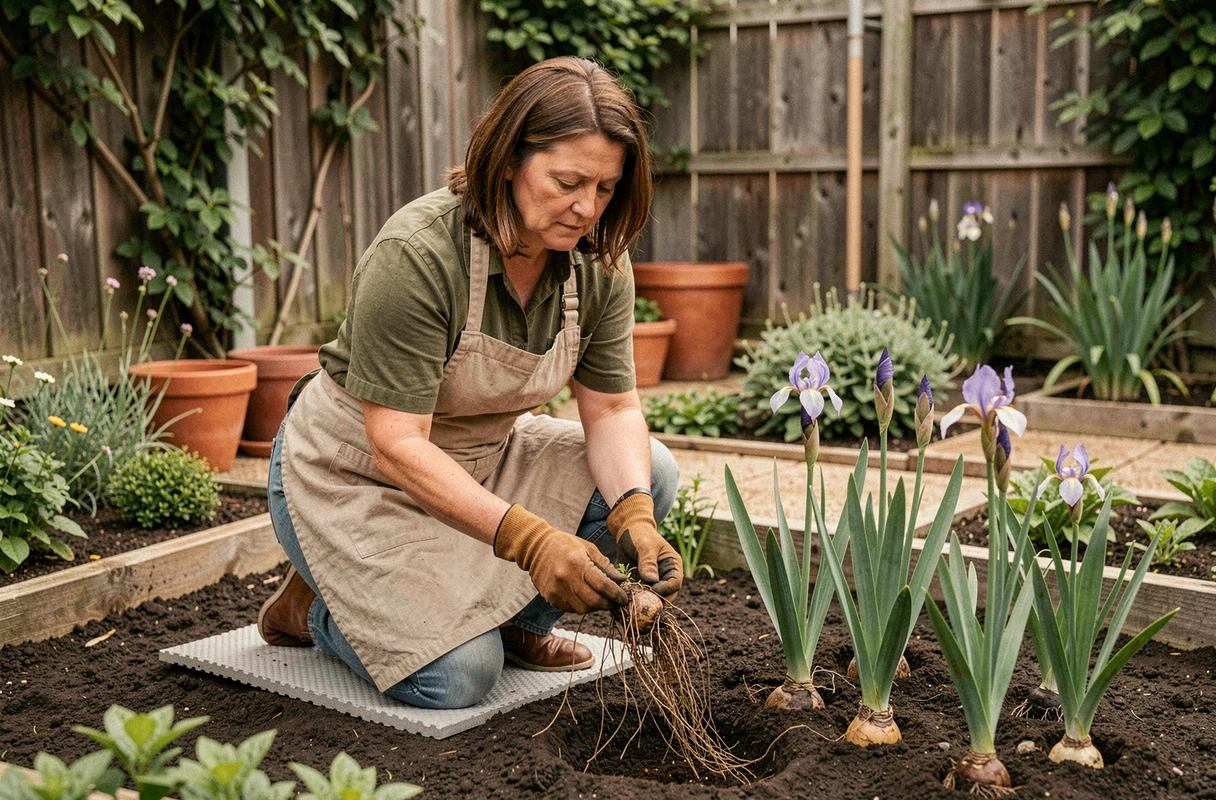
- Cut the clumps with a clean knife, keeping at least two fans of leaves per portion
- Remove the central woody or soft parts, which will not regenerate
- Replant immediately at the same depth, rhizome covered with substrate (unlike the bearded iris, never exposed)
- Water moderately after division to encourage root recovery without causing rot
This regular thinning action is more decisive for flowering than any fertilizer application.
Indoor and pot cultivation: adapting the protocol
Neomarica northiana lends itself remarkably well to home cultivation, provided a few rules that outdoor cultivation does not impose are respected. The pot must be wide enough to accommodate the lateral expansion of the rhizomes but not too deep: a moderate substrate height is sufficient.
The fan-shaped foliage needs free vertical space for the stalks to bend naturally. Placing the plant at a height (on a shelf, an elevated support) facilitates the rooting of aerial seedlings if one wishes to reproduce the walking phenomenon indoors.
Watering in pots requires more vigilance than in the ground. The substrate should never dry out completely between waterings, but water should not stagnate in the saucer. In winter, reduce the frequency without allowing the substrate to become dusty.
Fertilization adapted to the Neomarica cycle
A diluted liquid organic fertilizer, applied once a month from spring to early autumn, supports flowering without forcing leaf growth. Formulations too rich in nitrogen produce lush foliage at the expense of flowers. We recommend a balanced fertilizer or one slightly dosed with potassium.
The walking iris remains a low-maintenance plant once its basic conditions are respected. Cool soil, filtered light, regular division: these three parameters cover almost all cultivation issues encountered. The rest, the plant takes care of, stalk by stalk, gently walking toward the next available patch of soil.