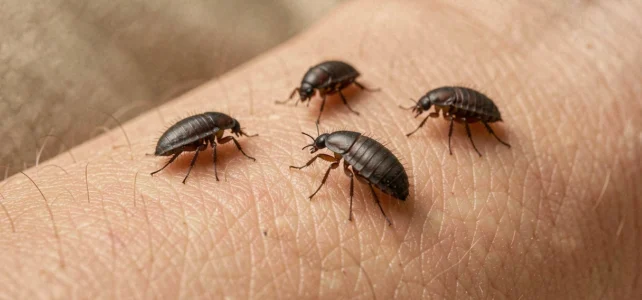
A small black creature jumps on the bathroom tiles or on the edge of the bathtub. Immediate reflex: think of fleas. This confusion is common, but the most frequent culprit in damp areas is not a blood-sucking parasite. It is often a springtail, a tiny arthropod attracted to moisture, whose presence tells more about the state of your home than that of your pet.
Springtail or flea: the test that decides in seconds
Before emptying a bottle of insecticide, take thirty seconds to observe the creature. The location where it appears already gives a reliable clue.
A springtail is found near a water source: bathroom, kitchen, flower pot, damp basement. A flea, on the other hand, stays close to its host. You will find it on a dog cushion, in a carpet, or on a fabric sofa.
Next, look at the shape of the body. The flea has a laterally flattened body, as if pinched between two fingers. The springtail has a globular or elongated body, sometimes comma-shaped. The difference is visible to the naked eye if you manage to immobilize the insect on a light surface.
Knowing how to recognize a jumping black creature relies on this simple combination: discovery location, body shape, and presence or absence of bites on the skin.
Photographic method to confirm identification
You may have noticed that describing a creature a few millimeters long from memory is almost impossible? A photo is an underestimated tool in this type of situation.

Capture the creature (a piece of adhesive tape works well) and place it on a white background. Add a scale object next to it, such as a coin or the tip of a pen. Take the photo with your phone’s zoom in natural light.
A sticky trap left on the ground for 48 hours allows you to measure whether the problem is occasional or recurring. Count the captures after two days. A few individuals indicate a temporary presence. Dozens stuck to the trap signal a persistent humidity problem or, in the case of fleas, an active infestation.
This method has another advantage: if you need to contact a professional, the photo with scale and the sticky trap provide concrete elements to guide their diagnosis remotely.
Fleas in the home: textiles as a breeding ground
When the jumping black insect is indeed a flea, treatment cannot be limited to the pet. Fleas lay eggs in textiles, not on the animal. Carpets, rugs, cushions, cracks in the floor, bedding: these are breeding areas.
Here are the actions to prioritize:
- Thoroughly vacuum all textile surfaces and corners of the floor, then immediately throw away the bag or empty the vacuum bin outside the home.
- Wash at high temperature the covers, sheets, throws, and cushions that have been in contact with the animal.
- Treat the animal with an appropriate antiparasitic (spot-on, tablet, or collar as per veterinary advice) alongside the treatment of the home.
Treating only the animal leaves the eggs and larvae intact indoors. They hatch a few days later, and the cycle starts again.
Bed bugs, a false twin to rule out
Bed bugs do not jump. This is a quick exclusion criterion. If the creature jumps, it is not a bed bug. Bed bugs move by crawling and hide in mattress seams, bed slats, and behind baseboards. Their bites form lines or clusters on the skin, often upon waking.
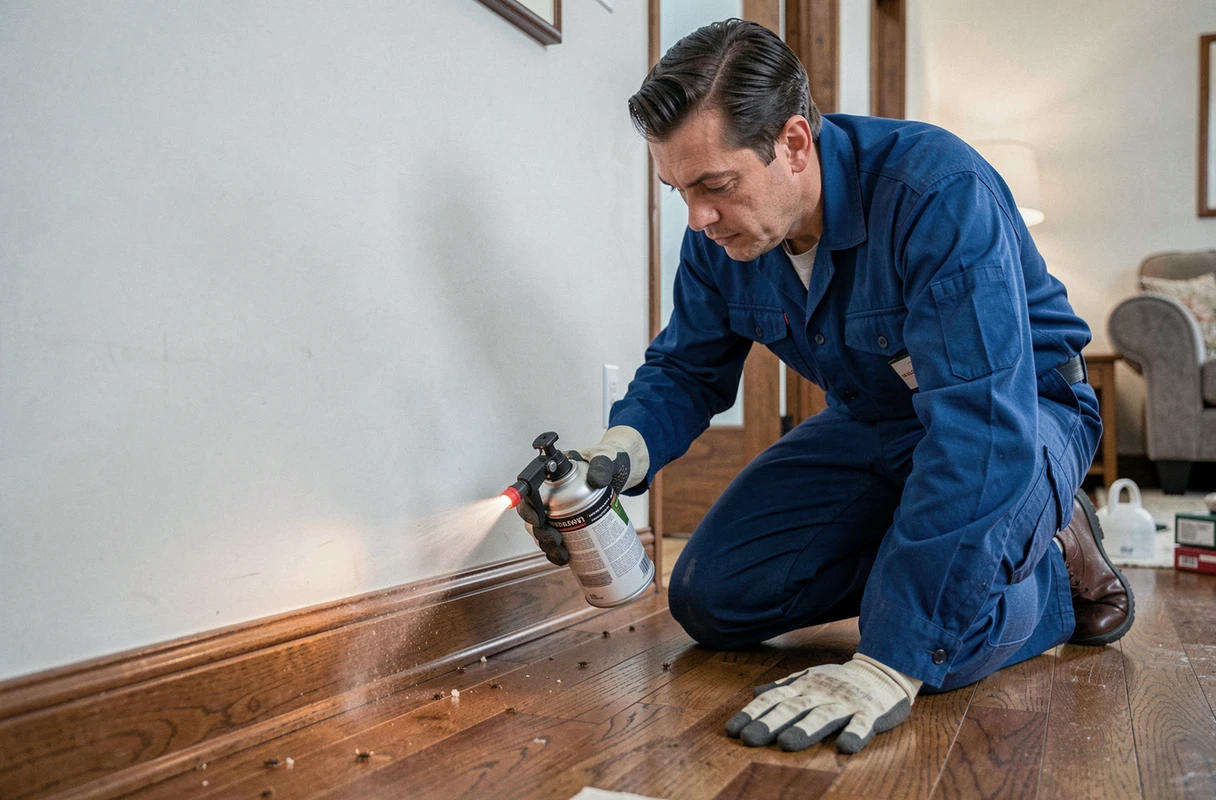
Jumping black creature in the bathroom: correct humidity before any treatment
If your identification points to the springtail, no insecticide is necessary in most cases. This small arthropod feeds on microscopic mold and decaying organic matter. Its presence indicates excess humidity in the room.
Corrective actions are more effective than a chemical treatment:
- Check for leaks under the sink, around the bathtub, and behind the toilet.
- Ventilate the bathroom for at least ten minutes a day, with the window open or the ventilation system running.
- Clean the grout and condensation areas where mold develops.
- Seal cracks in the walls and around pipes, frequent entry points.
Reducing humidity makes springtails disappear in a few weeks, without chemical products. If despite these corrections the population persists, a hygrometer can check that the indoor humidity level remains under control. An abnormally high level may reveal a structural problem (rising damp, insulation defect).
When to call a professional for an infestation
A handful of springtails in the shower does not justify an intervention. However, certain signals should raise alarms.
Repeated bites on the occupants of the home point towards fleas or, more rarely, parasitic mites. In this case, a professional diagnosis can precisely identify the species and adapt the treatment.
If you set a sticky trap and the capture remains abundant after correcting the sources of humidity, the problem exceeds the simple opportunistic springtail. A professional can inspect technical areas (crawl spaces, ducts, false ceilings) that are not accessible on a daily basis.
The right reflex remains to document before acting: clear photos, dated sticky trap, precise location in the home. These elements prevent inappropriate treatment and allow the technician to target their intervention from the first visit.