
The market for household vacuum machines has changed status in recent years. What was once considered a niche equipment, reserved for advanced cooking enthusiasts or hunters, has become a common tool in European kitchens.
Batch cooking, low-temperature cooking, and the desire to reduce food waste have accelerated this normalization. In this context, the Magic Vac Maxima 2 is among the devices frequently mentioned by French-speaking users. It remains to understand what specifically distinguishes it from the available alternatives.
PFAS Regulation and Food Packaging: What Changes for Vacuum Sealing
The compatibility of vacuum bags with the new standards on food contact materials deserves special attention.
Since January 1, 2026, France prohibits PFAS in food packaging made of paper or cardboard. This ban is part of a broader European dynamic.
For a vacuum machine user, this means that the choice of bags and rolls is no longer trivial. The embossed polyethylene or PA/PE bags, compatible with most external suction machines like the Maxima 2, meet the food contact requirements defined by the Consumer Code. In contrast, some cheap bags imported from outside the EU do not guarantee this compliance.
The Maxima 2 accepts different formats of plastic bags, including cuttable rolls. This versatility allows users to select consumables that comply with French and European standards without being tied to a proprietary format, which is not the case for all competing devices.
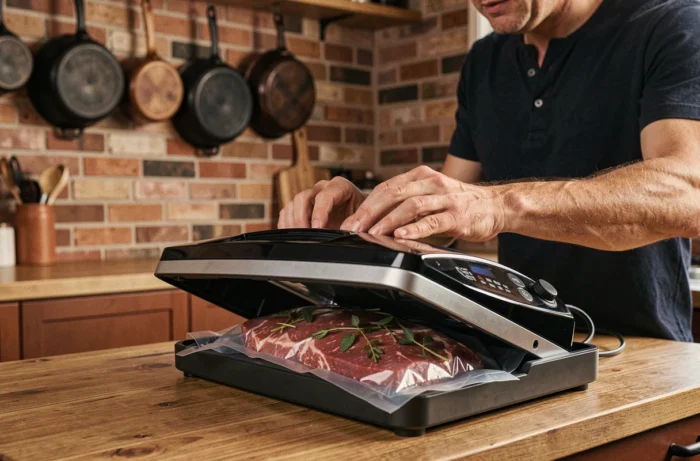
It is also possible to discover the Magic Vac Maxima 2 with details of its bag and roll compatibilities, a criterion often overlooked during purchase.
Sealing and Suction of the Magic Vac Maxima 2: Technical Overview
The quality of the seal determines the actual shelf life. A poorly sealed bag allows air in within a few days, which negates the purpose of vacuum sealing. On this point, the Maxima 2 stands out with a sequential trigger automatic sealing system: the device vacuums, then seals without additional manual intervention.
The sealing bar produces a joint wide enough to withstand freezing and repeated handling (freezer removals, cooking baths). User feedback converges on the reliability of this seal, even with bags containing partial liquids like marinades.
Suction Speed and Management of Delicate Foods
The vacuum generated by the pump is powerful enough for common household use: meats, vegetables, cooked dishes. User feedback varies on this point for very moist foods or abundant liquid preparations, where suction may draw liquid towards the sealing area.
For delicate foods (soft fruits, pastries), the ability to manually interrupt suction before crushing exists on the Maxima 2, but it requires some practice to correctly gauge the pressure. This is not a flaw unique to this model: all external suction machines share this mechanical limitation.
Magic Vac Vacuum Machine vs. FoodSaver: Concrete Comparison
The name FoodSaver consistently comes up when comparing household vacuum machines. The main difference does not lie in raw power, which is comparable in mid-range models from both brands.
- The Maxima 2 accepts generic bags and rolls, whereas some FoodSaver models work specifically with their own consumables, increasing the long-term cost of use.
- The cost of consumables over several years often outweighs the purchase price of the machine, a factor that online comparisons tend to underestimate.
The purchase price of the Maxima 2 is slightly higher than that of entry-level FoodSaver models. Available data does not allow for a conclusion on long-term durability differences between the two brands, but the freedom in choosing bags constitutes a measurable economic advantage.
Known Limitations of the Maxima 2 and Real Use Cases
No external suction machine can replace a professional vacuum chamber. The Maxima 2 is no exception to this rule.
Vacuum sealing pure liquids (soups, sauces) remains complicated without pre-freezing the contents. This is a physical constraint related to the principle of suction at the edge of the bag, not a design flaw. For this type of use, only chamber machines (starting at several hundred euros) provide a direct solution.
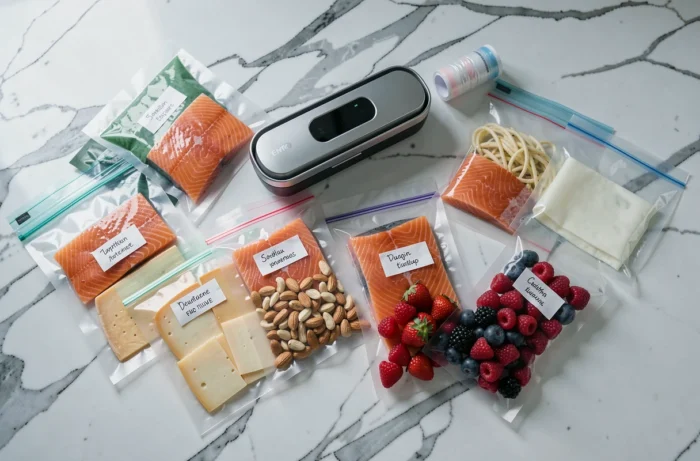
The Maxima 2 covers the majority of needs for a household that practices weekly batch cooking, preserves bulk-bought meats or fish, or prepares portions for freezing. Its compact format allows it to remain on a countertop without excessive clutter.
Maintenance and Lifespan
Cleaning the sealing area and the suction channel is essential for the longevity of the device. A seal clogged with food residues degrades the vacuum quality within weeks. The Maxima 2 provides easy access to these areas, simplifying regular maintenance.
Spare parts (seals, sealing bars) are available through the Magic Vac network, a point that deserves verification before purchasing any vacuum machine, regardless of the brand. A device whose wear parts are no longer distributed after two or three years becomes premature waste.
The choice of a household vacuum machine relies on three criteria that are rarely prioritized: the compatibility of consumables with current food safety standards, the actual cost of use over several years, and the repairability of the device.