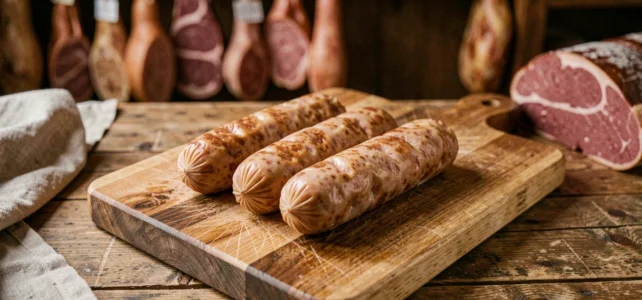
The Frankfurt sausage is among the most consumed charcuterie products in Europe and North America. Behind this cylinder of smoked pork meat, a geographical and technical trajectory deserves to be measured: who actually invented it, where, and how has it transformed as it crossed borders?
Answers vary depending on the sources. The discrepancies between the German version, the Austrian version, and the American version reveal differences in composition, regulation, and cultural status.
Frankfurt, Vienna, or New York: three claims for one sausage
The paternity of the Frankfurt sausage is the subject of a historical dispute between two German-speaking cities. Frankfurt am Main claims a manufacturing tradition dating back to the Middle Ages. The city allegedly used this type of sausage during the coronation ceremonies of the emperors of the Holy Roman Empire.
In contrast, Vienna highlights the role of Johann Georg Lahner, a butcher from Frankfurt who settled in the Austrian capital in the early 19th century. Lahner is said to have modified the recipe by adding beef, creating what the Viennese still call today the Wiener Würstchen (Viennese sausage).
| Criterion | Frankfurt Version (Frankfurter Würstchen) | Vienna Version (Wiener Würstchen) | American Version (hot dog) |
|---|---|---|---|
| Main meat | Pork | Pork and beef | Pork, beef, or variable mix |
| Casings | Natural sheep casing | Natural casing | Often artificial casing |
| Smoking | Traditional cold smoking | Adapted smoking by Lahner | Variable depending on the manufacturer |
| Regulatory status | Protected designation in Germany | Common name without specific protection | No protected designation |
| Serving method | Poached, served with bread | Poached, accompanied by mustard | In a split bun, topped with condiments |
The history of the Frankfurt sausage shows that each country has reformulated the product according to its own food codes. The table above reveals a rarely highlighted point: only the German version has a protected designation, which restricts the use of the term Frankfurter Würstchen to sausages made in the Frankfurt region.

Composition of the classic Frankfurt: what the casing really contains
The standard composition of a German Frankfurt sausage is based on pork meat (about 68%), supplemented by water, pork fat, and salt. The casing used is a natural sheep casing, finer than that of Strasbourg sausages or industrial knacks.
This precision regarding the sheep casing changes the final texture. A fine natural casing produces a characteristic crunch upon biting, whereas an artificial casing provides a more uniform and less pronounced resistance.
- Salt and spices (nutmeg, white pepper, sometimes mace) make up the traditional seasoning, with no added coloring in the authentic version.
- Smoking is traditionally done with beech wood, which gives the sausage its golden color and distinct aroma compared to simple poaching.
- The preparation involves very fine grinding of the mixture, more so than for a Toulouse sausage, for example, resulting in a smooth and homogeneous texture.
In France, sausages sold under the name “Francfort” in large retail often deviate from this recipe. The sheep casing is frequently replaced by a collagen casing, and the meat content can vary by brand.
From Frankfurt to New York: how the sausage became a hot dog
German emigration to the United States in the 19th century transported the Frankfurt sausage across the Atlantic. Germanic street vendors began offering these sausages on the streets of New York, slipped into a small bun for easier consumption while standing.
The term “hot dog” appeared later. Several hypotheses circulate regarding its exact origin, but the most documented refers to press caricatures that associated the elongated shape of the sausage with that of the dachshund, a very popular German dog breed at the time. The link between the dachshund and the sausage gave rise to the nickname “dachshund sausage”, later simplified to hot dog.
What distinguishes the American journey from the European one is industrial standardization. In the United States, the recipe adapted to the constraints of mass production: a mix of meats (pork, beef, sometimes poultry), artificial casings, the addition of preservatives and colorings. The American hot dog and the Frankfurter Würstchen no longer share much in terms of composition, even though the genealogical link remains direct.
European regulation and the future of meat designations
A reform adopted by the European Union in 2026 will come into effect in August 2029, with a transition period until 2032. This reform reserves certain designations traditionally associated with animal origin products solely for meat products.
The term “sausage” remains usable for plant-based alternatives. However, words like “bacon,” “steak,” or “liver” will be prohibited for designating products made from plants, mushrooms, or cell culture. This regulatory distinction reinforces the boundary between traditional Frankfurt and its plant-based imitations.
On the side of German manufacturers, the shift has already begun. Rügenwalder Mühle, one of the leading sausage producers in Germany, has redirected about 76% of its portfolio towards vegetarian or vegan products. A signal that shows the sausage market, including that of the Frankfurt, is transforming due to both demand and regulation.
The Frankfurt sausage remains a food case study where geographical origin, technical composition, and legal framework tell three parallel stories. The version that ends up in a hot dog in Manhattan and the one that comes out of a butcher shop in Frankfurt am Main share a common ancestor, but their trajectories have diverged to the point of producing two distinct products, united by a name and separated by nearly everything else.