
Interior architecture and product design share a common foundation: giving shape to a use, balancing aesthetics and technical constraints, and engaging with manufacturers or artisans. Both professions attract creative profiles, often trained in the same applied arts schools. However, their daily routines diverge as soon as they leave the design studio.
Comparing these two paths requires looking at what each professional actually does during their days: the type of deliverables they produce, the stakeholders they manage, the legal framework in which they operate, and the timeline of their projects.
Scope of intervention and legal responsibility: the real divide
The first gap between these two professions lies not in creativity, but in the technical and legal responsibility carried on a daily basis. The interior architect redistributes volumes, modifies partitions, and coordinates trades on a construction site. Their scope touches on accessibility, ventilation, acoustics, and electricity. They take responsibility for the compliance of the work carried out.
The designer, on the other hand, creates an object intended for mass production or small series. Their responsibility lies in industrial feasibility, material selection, and compliance with the standards of the finished product. They do not coordinate artisans on site; they engage with process engineers and industrial subcontractors.
To better understand the differences between interior architecture and product design, one must closely observe the expected deliverables from each side, as this is where the days cease to resemble each other.
| Criterion | Interior Architecture | Product Design |
|---|---|---|
| Work Object | Existing built space (housing, office, commercial) | Object or system intended for manufacturing |
| Main Deliverables | Execution plans, measurements, detail notebooks, site monitoring | Models, prototypes, CAD files for tooling |
| Field Stakeholders | Artisans, project owner, control offices | Product engineers, industrial buyers, manufacturers |
| Regulatory Framework | Accessibility standards, fire safety, DTU | Product standards (CE, REACH, food safety according to sector) |
| Average Project Duration | Several months to over a year (including construction) | Variable, from a few weeks (furniture) to several years (electronics) |
| Dominant Work Location | Alternating between office and construction site | Design office / prototyping workshop |
Field Skills in Interior Architecture: Well Beyond Drawing
Interior architecture programs now include reading execution plans, measurements, budget management, and 3D modeling usable by artisans. This shift towards skills in operational project management reflects the reality of the profession: a significant portion of time is dedicated to site monitoring, not to trend boards.
An interior architect restructuring an apartment spends their mornings checking electrical reservations, validating tile layouts, and resolving scheduling conflicts between drywall installers and plumbers. In the evening, they update their plans and prepare site reports.
The skills that differentiate this profile from a decorator:
- Ability to produce technical documents (sections, elevations, assembly details) readable by an artisan without interpretation
- Knowledge of regulatory constraints related to PMR accessibility, fire safety, and current electrical standards
- Effective coordination of multiple trades on a constrained construction schedule, managing unforeseen events (delivery delays, non-compliance)
- Project-by-project budget management, including negotiation of quotes and monitoring of payment situations
This field dimension is often underestimated by students who enter training with the idea of “doing decoration.” The daily routine resembles that of a building project manager more than that of a stylist.
Product Design: A Daily Life Focused on Industrialization
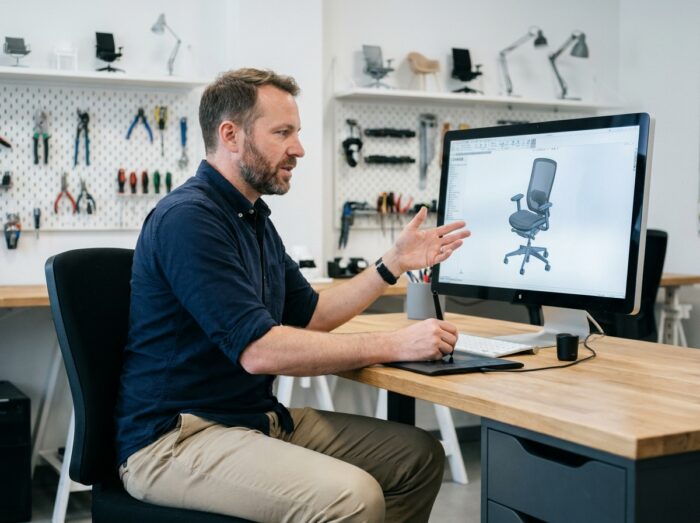
The product designer works on a different cycle. Their typical day starts with a review of models or prototypes, continues with discussions with an engineer about manufacturing tolerances, and may end with a user test or a presentation to the marketing department.
The central constraint is not the construction site, but industrial feasibility at controlled cost. A designer creating a chair must simultaneously consider ergonomics, injection mold or cutting template, target unit cost, and mechanical resistance standards.
In contrast, the product designer rarely works on-site. They do not manage a direct relationship with an end client during the usage phase. Their field feedback comes from usage studies, after-sales data, or consumer panels, not from a construction site visit at 7 a.m.
This distance from the end user constitutes a structural difference. The interior architect lives in the space they transform, notices their mistakes in real time, and adjusts throughout the project. The product designer only sees actual usage after the product hits the market.
Training Path and Career Evolution: Intersecting Trajectories
Both professions often share the first years of study in applied arts schools or design programs. The divergence usually occurs from the specialization: space option for interior architecture, object or industry option for product design.
Bridges exist. A product designer can evolve towards the design of commercial spaces (retail design), while an interior architect can specialize in custom furniture and shift towards object design.
The cross-disciplinary skills that facilitate these transitions:
- Mastery of 3D modeling software (Rhino, SketchUp, SolidWorks depending on the field)
- Sufficient material culture to engage with specialized manufacturers
- Ability to present a project convincingly to a client or a management committee
Conversely, the skills that do not transfer easily are the most technical: knowledge of DTU and construction standards for the interior architect, mastery of industrial manufacturing processes for the product designer.

The choice between these two paths is less about creative sensitivity than about the relationship to the field. One spends part of their days on-site, helmet on head, mediating between what has been drawn and what is feasible within deadlines. The other stays longer in the design office but must deal with the constraints of a production line they do not directly control. Two forms of pragmatism, applied at different scales.