The choice of children’s underwear is based on technical criteria that most guides summarize as “choose cotton.” We find that recurring issues (irritations, refusal to wear certain models, elastics that mark the skin) almost always stem from a construction defect rather than a poor choice of material. Understanding the mechanics of children’s underwear allows for the elimination of most of these inconveniences right from the purchase.
Weight and textile structure of children’s underwear
A cotton fabric can be excellent or mediocre depending on its weight and knitting. For underwear worn directly against the skin, an interlock jersey offers a smooth surface on both sides, unlike single jersey which has a rough technical side against the skin. This difference in textile construction is rarely mentioned on consumer labels.
The weight determines durability and thermal comfort. A fabric that is too thin deforms after a few washes and loses its elasticity. A fabric that is too heavy traps heat, which promotes maceration. We recommend feeling the fabric: it should resist slight stretching without being rigid.
The addition of elastane to cotton improves support, but beyond an excessive proportion, the fabric loses its absorption capacity. A cotton-elastane blend remains the most reliable standard for children’s underwear, provided that cotton remains the predominant component.
For everything you need to know about children’s underwear, the textile composition remains the first criterion to check even before size or color.
Seams and finishes: the details that cause rejection
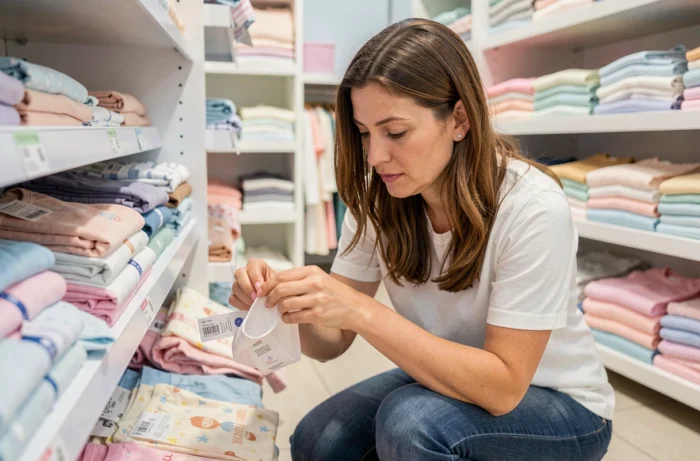
A child who refuses to wear their underwear often expresses discomfort related to the finishes, not the model itself. Classic side seams create a bulk that rubs against the hip. Models with flat seams or ultrasonic welded seams eliminate this bulk and significantly reduce irritations.
The composition label sewn into the back of the panties or boxers remains one of the most common irritants. Some manufacturers now print the information directly onto the fabric. When the label is sewn, removing it with scissors often leaves a rough fabric residue that exacerbates the problem. It is better to prioritize models without labels right from the purchase.
Waist and thigh elastics
The waistband elastic is the number one friction point. A covered elastic (wrapped in fabric across its entire width) does not mark the skin, unlike an exposed elastic that exerts linear pressure on a narrow point. For the thighs, a laser-cut edge avoids any compression and eliminates the risk of red marks after a day at school.
Decorative topstitching adds unnecessary layers of thread. They stiffen the area concerned and create hard points. The most comfortable underwear is often the most visually understated.
Size of children’s underwear: beyond the age-weight chart
Size charts based solely on age are unreliable. A 6-year-old may wear a size 4 in waist and a size 8 in leg length. The hip measurement taken flat determines the actual size, not the age printed on the packaging.
In practice, we observe that most comfort issues arise from underwear that is too large (the elastic compensates by tightening more) or too small (permanent compression). The test is simple: once worn, one should be able to slide a finger under the waistband elastic without forcing.
- Measure the hip circumference at the widest point, above the buttocks, with a soft measuring tape without tightening.
- Compare this measurement to the manufacturer’s chart rather than the age indicated on the packaging.
- Check that the inseam of the model corresponds to the morphology: too short, it rides up and irritates; too long, it forms folds.
- Test the elastic flat before cutting the labels: if it leaves a mark after 30 seconds of pressure on the wrist, it will also mark the child’s skin.
Oeko-Tex Class I certification and chemical residues on the skin
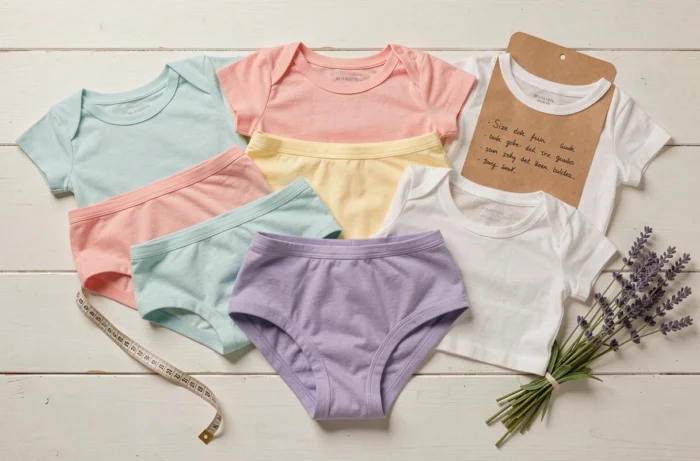
The Oeko-Tex Standard 100 Class I certification is the most restrictive of the standard. It concerns textiles intended for babies and young children, with lowered tolerance thresholds for dye residues, heavy metals, and formaldehyde.
Underwear is in prolonged contact with areas of fine and moist skin (groin folds, buttocks). Treatment residues migrate more easily under these conditions. An uncertified piece of underwear is not necessarily dangerous, but certification provides a guarantee of laboratory testing for regulated substances.
The issue of PFAS (per- and polyfluoroalkyl substances) in textiles is receiving increasing attention at the European level. These persistent compounds are used in some water-repellent or stain-resistant treatments. For children’s underwear, the risk mainly concerns models treated “anti-odor” or “moisture-wicking” by chemical rather than mechanical means.
First wash before use
Any new underwear must be washed before being worn. This first cycle removes manufacturing finishes (smoothing agents, gluing residues) that can cause reactions on sensitive skin. A wash at 40 °C with a detergent free of fragrance and allergenic preservatives is sufficient.
- Wash separately from other textiles during the first cycle to avoid dye transfers.
- Avoid fabric softeners that leave a film on the fibers and reduce the absorption capacity of cotton.
- Air dry rather than tumble dry to preserve the elasticity of the fibers during the first uses.
The European GPSR regulation (Regulation (EU) 2023/988), strengthened since 2024, imposes increased requirements on the safety of clothing intended for children under 14 years old. The EN 14682:2015 standard prohibits any cord at the head and neck level for those under 7 years old. This preventive logic also applies to decorative cords sometimes present on pajamas worn over underwear, a point that parents rarely check at purchase.
Choosing suitable underwear for a child is less about marketing and more about carefully reading a composition label, manually testing the elastic, and accurately measuring the hips. The most expensive models are not necessarily the best constructed. A certified Class I interlock cotton, without visible side seams and with a covered elastic, meets almost all daily comfort needs.