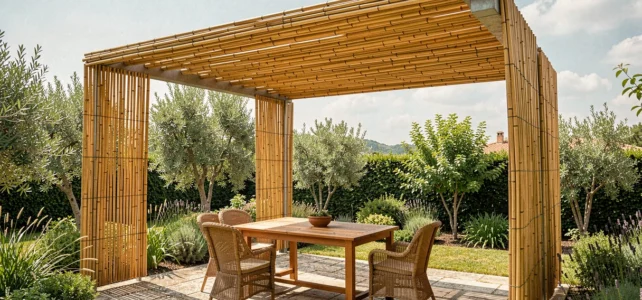
Bamboo screening remains one of the most commonly used coverings for garden or terrace pergolas. Its natural appearance is appealing, its price is accessible, and its installation does not require special skills. However, choosing this material to cover a structure exposed to the elements deserves careful consideration of its actual long-term performance.
Behavior of bamboo on pergola roofs: what field feedback shows
When laid horizontally on a pergola, bamboo screening faces different constraints than a vertical privacy screen fixed to a fence. Water stagnates between the stems after each rain, the sun shines directly overhead in summer, and the wind lifts the edges if the fastening is insufficient.
Feedback from landscapers and installers converges on one point: a well-installed and maintained bamboo screen lasts between 3 and 7 years. This figure strongly depends on exposure (full south or partial shade), the quality of the stems, and the maintenance applied. By comparison, a natural reed screen typically lasts between 3 and 5 years, while synthetic alternatives in PVC or HDPE often reach 10 to 15 years.
Those considering bamboo screening for pergolas should incorporate this lifespan into their overall budget calculation, including installation and replacement.
Natural or synthetic bamboo screening: two products, two logics
The term “bamboo screening” encompasses two distinct realities that must be separated before making a choice.
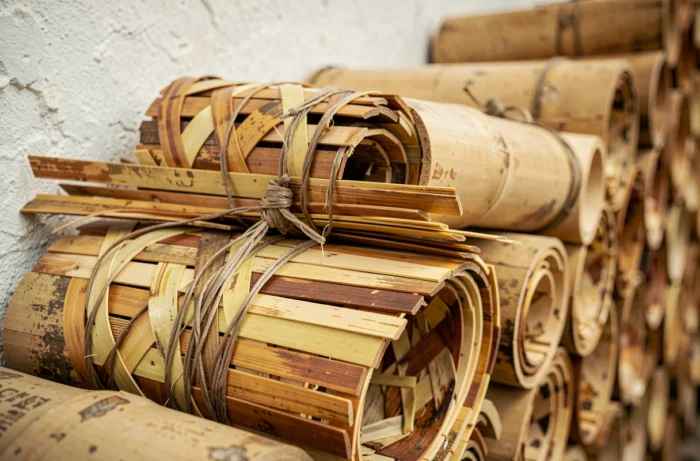
Natural bamboo stems
Dried stems, connected by galvanized wire or twine. The result is authentic, with a raw touch. Natural bamboo turns gray over time due to UV exposure, which some people like and others dislike. Without treatment (linseed oil, saturator), the stems crack after a few seasons, especially in a horizontal position where moisture accumulates.
Synthetic bamboo imitation screening
Made from PVC or HDPE resin, it replicates the appearance of bamboo without its biological constraints. No regular maintenance is required, and its longevity is significantly superior. However, the visual result up close does not deceive, and the plastic feel may disappoint on a wooden pergola where a consistency of natural materials is sought.
The choice between the two depends on the priority given to aesthetics or longevity. Field feedback varies on this point: some prefer to replace a natural screen every four or five years rather than live with a synthetic look for a decade.
Shade level and protection: the concrete limits of bamboo
Bamboo screening does not function like a stretched shade cloth. Its structure allows some light to pass between the stems, creating a pleasant play of shadows but does not guarantee total sun protection.
- Light blockage varies according to the diameter and spacing of the stems: models with thin, closely spaced stems block more light but also reduce air circulation under the pergola
- Rain protection is almost non-existent: water passes through the screening, excluding its use as a waterproof covering without adding a cloth or film underneath
- Wind penetrates less than through an open trellis, but the screening does not provide reliable windbreak protection, especially if laid in a single layer on a high pergola
For dense shading, the screening should be doubled or combined with a cloth. This mixed solution works well in practice: the cloth ensures waterproofing, while the bamboo screening provides the visual appeal on the exterior side.
Fixing on pergola: mistakes that shorten lifespan
Installing bamboo screening on a pergola seems simple. It is, provided you avoid a few recurring pitfalls.
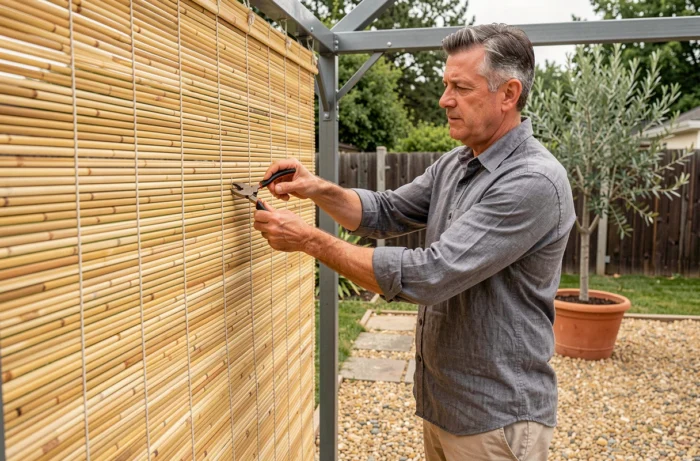
Standard wire rusts within months outdoors. Using stainless steel wire or UV-resistant plastic ties extends the durability of the fastening. Fasteners should be placed every 20 to 30 centimeters on each crossbeam of the pergola to prevent the wind from lifting or deforming the screening.
The most common mistake is laying the screening flat without any slope. Water then stagnates in the dips formed by the stems, accelerating the rotting of natural bamboo and promoting mold growth. Even a slight incline is enough to drain rainwater.
Another often overlooked point: natural bamboo reacts to humidity. It swells, contracts, and can deform if the fastenings are too rigid. Allowing a slight play in the fasteners enables the stems to move without breaking.
Bamboo in pergolas and overall landscaping project: a regulatory point to know
The screening placed on a pergola does not pose a legal problem in itself. However, when the choice of bamboo is part of a larger project including bamboo plantings forming a hedge or green privacy screen, recent regulations deserve attention.
Since the law of April 15, 2024, a new article 1253 of the Civil Code holds the author of an abnormal neighborhood disturbance fully liable, even if they were unaware of the risk. The spread of creeping bamboo rhizomes into a neighboring property falls under this framework. This point does not directly concern the screening itself, but it weighs on the coherence of a landscaping project entirely oriented towards bamboo.
Distinguishing the screening (an inert product, without roots) from living bamboo (a potentially invasive plant) avoids any confusion in a garden or terrace project.
Bamboo screening remains a relevant choice for dressing a pergola at a lower cost with a natural look. Its limited lifespan and lack of waterproofing are its two real weaknesses. Integrating these from the start into the project allows for informed choices, without unpleasant surprises in the first rainy season.