A sloped terrain, clay soil, a high water table: even before discussing budget, it’s the land that sets the rules for a pool. The price of a pool depends less on the chosen catalog than on the constraints discovered during excavation, and ecological options add an additional layer of decision-making that is often underestimated.
Soil Constraints and Excavation Costs Before the First Quote
You receive an attractive quote, you sign, and then the excavator encounters rock or a high water table. The extra excavation costs can represent a significant portion of the initial budget when the soil does not cooperate.
Clay soil expands and contracts with the seasons. For an inground pool, this requires a reinforced slab and sometimes complete peripheral drainage. On sloped land, retaining walls must be added, and the removal of excess soil must be planned, which increases transport costs.
Before comparing pool prices at Alter Ec Home or elsewhere, a soil study (G2 AVP study) is recommended. It costs a few hundred euros but avoids unpleasant surprises that can amount to thousands. The soil study determines the actual budget of the project, much more than the shape or size of the pool.
Pool Prices According to Construction Type: Shell, Concrete, or Kit
The three main construction families do not operate in the same league, either in budget or site constraints.
Polyester Shell Pool
This is the quickest option to install. The pool arrives prefabricated, and installation usually takes a few days once excavation is complete. The budget remains accessible for an inground pool, but you are limited to the shapes and dimensions offered by the manufacturer.
Concrete Pool (Poured or Shotcrete)
Concrete offers total freedom in dimensions, depth, and shape. The price rises accordingly, and the construction lasts several weeks. Concrete is chosen when the terrain or architectural project requires it, not by default.
Construction Kit
The kit is suitable for experienced DIYers who want to reduce labor costs. The block forms or modular panels allow you to build the structure yourself, with a significantly lower starting budget. Feedback varies on this point: some self-construction projects drag on due to lack of experience, and savings diminish if a professional needs to be called in midway.
Water Treatment and Regulations: The Hidden Cost of an Ecological Pool
The price of a pool does not stop at construction. The maintenance item, often minimized in quotes, weighs on the budget each year. And regulations are tightening.
In sensitive areas, discharging pool water into natural environments is now prohibited. This includes rivers, lakes, and aquifers. In practice, you must either connect the drainage to the sewage system or treat the water on-site before any discharge. This technical point directly influences the choice of treatment system and the frequency of drainage.
- Chlorine remains the cheapest treatment to purchase, but it requires regular pH monitoring and generates irritating by-products for the skin and mucous membranes.
- Salt (electrolysis) reduces the handling of chemicals. The initial cost of the electrolyzer is higher, but ongoing maintenance is cheaper over several years.
- UV or ozone treatment significantly reduces the amount of disinfectant needed. These systems consume electricity but limit chemical discharges, a direct advantage in areas where discharge regulations are tightening.
Solar Heating or Heat Pump: What Impact on the Annual Budget
Heating your pool represents the second largest expense after construction, especially if you want to extend the swimming season beyond summer.
Solar Mats and Panels
Solar mats placed on the ground capture heat from sunlight and transfer it to the pool water. The initial investment remains moderate, and operation costs nothing in energy. The limitation: the efficiency directly depends on sunlight exposure and the surface area of installed collectors. In less sunny regions, you gain a few degrees, rarely more.
If the house already has photovoltaic panels on the roof, you can power an electric heater or heat pump with the surplus production. The additional investment is then marginal.
Pool Heat Pump
The heat pump (PAC) extracts calories from the outside air to heat the water. Its performance coefficient allows it to return several times the electrical energy consumed in the form of heat. It is the most common solution for reliable temperature increases, even in overcast weather.
The purchase cost varies according to power and brand. You also need to consider the annual electricity consumption, which remains significantly lower than direct electric heating.
Natural Pool and Biological Basin: A Separate Budget
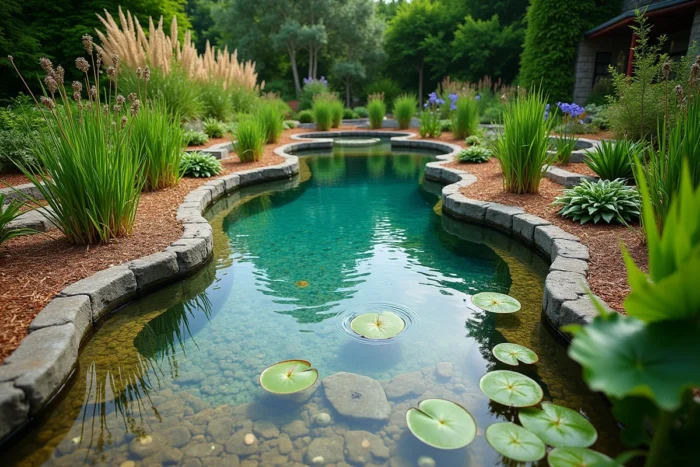
The natural pool operates without chemicals. Purification relies on a planted lagoon basin, where plants and microorganisms biologically filter the water.
The construction cost is often higher than that of a conventional pool of equivalent size because the lagoon area practically doubles the required surface area. More excavation, specific substrates, and an adapted hydraulic circuit are needed.
- The total surface area (swimming basin + filtration area) requires a garden that is large enough.
- Maintenance involves trimming plants, cleaning biological filters, and monitoring the ecosystem’s balance, not dosing chlorine.
- Swimming is possible once the ecosystem has stabilized, usually after a full season of maturation.
- No chemical discharge leaves the basin, simplifying compliance with discharge regulations in sensitive areas.
The biological basin appeals for its landscape integration and low environmental impact. But one must accept water that does not have the bluish transparency of a chlorine-treated pool, and coexistence with local wildlife (dragonflies, frogs).
The overall budget for a pool should be viewed over ten years, not just an initial quote. Maintenance, heating, and compliance costs weigh as much as the construction itself. Comparing pool types without including these recurring costs is like comparing purchase prices without considering usage costs.