A family business is more than a name passed down from parent to child. Its reputation is built on a combination of practices, material choices and working methods developed over several generations. The authentic craftsmanship of a family business lies in its ability to maintain consistently high standards, even as the people doing the work change.
Passing on artisanal expertise beyond the family circle
Have you ever noticed how some family businesses maintain the same quality for decades, even after their founders are no longer at the helm? It’s no coincidence. Craftsmanship is passed on through practical processes that go far beyond blood ties.
In Vaucluse, an artisan heating engineer says he wants to “give back what he was given as an apprentice.” This sums up a model in which apprenticeships underpin a family business’s continuity. Training an apprentice means passing on working habits, finishing standards and an approach to choosing materials.
The Yves Salomon fashion house is a good example of this approach. The furrier trains its artisans in-house and has applied their expertise to other collections, including furniture. Identity is preserved through methods, not products. The techniques endure, even as the items being made evolve.
This is precisely what the La Maison Montigny family puts into practice: an artisanal heritage that extends beyond family members and is shared with everyone trained within the business.
Authentic craftsmanship: what a family business really passes on
When people talk about authentic craftsmanship, they often think of a closely guarded manufacturing secret. The reality is more nuanced. What gets passed on are working habits, selection criteria and attention to details that no one else sees.
The three practical pillars of passing on expertise
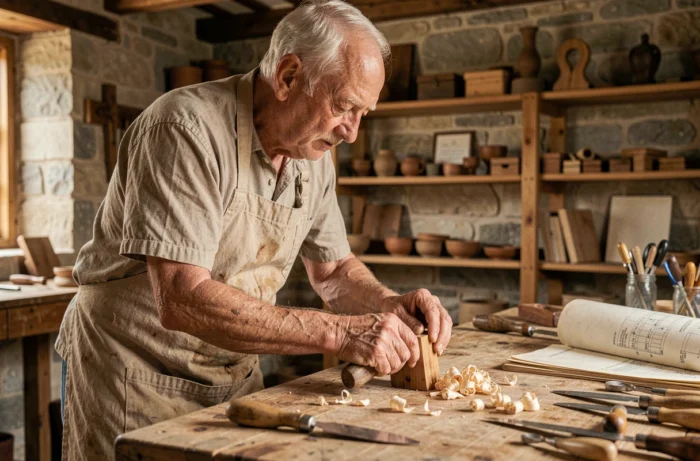
- Technical skills: Every business develops its own ways of working and sequences of movements that ensure consistent results. New artisans learn them through repetition alongside an experienced mentor, not from a manual.
- Choosing materials: Knowing how to recognize the quality of a raw material by its feel, smell or appearance. This skill can only be taught in real-world conditions, on the job.
- Finishing standards: The level of detail a business accepts or rejects defines its identity. Apprentices gradually absorb these criteria by seeing what passes inspection and what needs reworking.
Together, these three elements form a whole. Remove any one of them, and the finished product loses what sets it apart from standard industrial manufacturing.
Ensuring a family business’s future: the challenge of succession
Passing on an artisanal business is a different challenge from starting one. Launching a business and taking over an existing workshop require different skills. A successor must absorb years of accumulated knowledge in a limited time.
Taking over a family business involves more than its balance sheet. The successor inherits a customer base, tools and a way of organizing the work. Each of these bears the mark of previous generations.
Consider a simple example. A family-run carpentry workshop has custom-made templates that were built thirty years ago. They make it possible to reproduce parts with a level of precision that new tools cannot immediately match. A successor who throws them away loses part of the business’s expertise, perhaps without even realizing it.
What helps make a successful succession
Documenting processes helps, but it isn’t enough. A period of hands-on mentoring between the outgoing owner and the successor remains the most reliable approach. During this time, the successor observes, asks questions and understands why certain decisions are made in a particular way.
A business’s ability to attract a capable successor also depends on how clearly it presents itself. A business with clearly defined values, methods and products attracts people who are motivated by the project, not just the financial opportunity.
Evolving a business without betraying its identity
A family business that refuses to change will eventually disappear. One that changes too quickly loses what makes it recognizable. The balance comes down to a simple rule: methods endure, while products can evolve.
The Yves Salomon fashion house is a telling example. Artisans trained in furworking now apply their skills to textile collections and furniture. The techniques are the same. The standards are unchanged. Only the medium has changed.
This approach allows a family business to meet today’s expectations without disowning its history. A cabinetmaker skilled in traditional joinery can design contemporary furniture. A ceramicist trained in historic glazes can create pieces with modern lines.
Adapting does not mean diluting. It means the technical foundation is strong enough to be applied in new contexts. That foundation, rather than a fixed catalogue, is a family business’s true heritage.
A business that trains, passes on its expertise and adapts does not depend on a single person or generation. Its craftsmanship becomes a shared asset, carried forward by everyone who has trained there. This quiet but rigorous process is what distinguishes an authentic family business from an ordinary company with a family name.