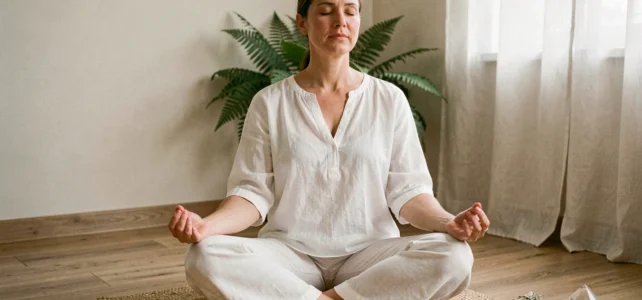
The energetic cleansing of the body encompasses very different practices, from fumigation to Reiki, including breathing exercises and chakra work. Their common point: to rebalance the circulation of energies in the body to enhance the feeling of well-being. Their divergence: the level of scientific evidence that accompanies them varies considerably from one technique to another.
Body energetic cleansing: what institutional sources say
Before comparing the techniques with each other, a factual framing is necessary. The National Center for Complementary and Integrative Health (NCCIH) reminds us that Reiki, one of the most popular practices in energy healing, has not been demonstrated as effective for treating a specific health problem. The institution adds that there is no scientific evidence of the “energy” that is supposed to act in this context.
Several review articles published between 2024 and 2025 describe a possible signal regarding comfort, anxiety reduction, or quality of life. The results remain mixed, with the quality of studies being heterogeneous. An effect perceived by participants does not prove an underlying energetic mechanism.
This does not mean that these practices are without interest. It means that the main risk is replacing a validated medical treatment with an energy healing, a point that several recent sources qualify as a strategic risk rather than a physical one. Some cancer centers even offer Reiki as a complement, never as a substitute.
Choosing among the body energetic cleansing methods therefore requires situating each technique along two axes: the type of feeling aimed for and the context in which it is practiced.
Comparison of energetic purification techniques
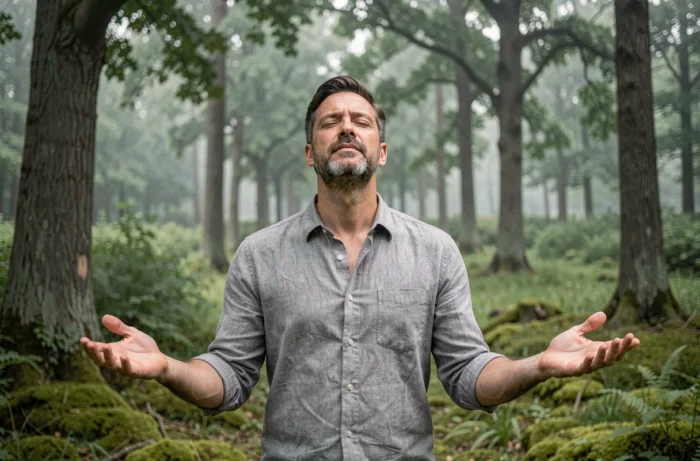
The table below classifies the main approaches according to their mode of action, accessibility, and context of practice.
| Technique | Main mode of action | Self-practice | Accompanied session | Validated complementary use in medical settings |
|---|---|---|---|---|
| Fumigation (sage, palo santo) | Purification of space and the body field through smoke | Yes | Optional | No |
| Salt bath (sea salt) | Absorption of tensions through immersion or application | Yes | No | No |
| Reiki | Hand placement, rebalancing of energy flow | Possible (self-Reiki) | Yes (trained practitioner) | Yes (as a complement, in some centers) |
| Meditation and visualization | Mental work on chakras and energy circulation | Yes | Optional (guided) | Yes (stress management, anxiety) |
| Breathing (pranayama, kapalabhati) | Stimulation of the nervous system through breath | Yes | Recommended initially | Yes (documented stress reduction) |
| Sounds (tibetan bowls, mantras) | Sound vibrations on the body and mental state | Possible | Yes (sound therapy) | No |
Two columns deserve attention. The “self-practice” column indicates that the majority of these techniques do not require a practitioner. In contrast, the “validated complementary use” column shows that only meditation, breathing, and Reiki appear in complementary medical contexts.
Energy rebalancing session: differences between solo and accompanied practice
The distinction between practicing alone and consulting an energy healer profoundly alters the experience. A salt bath or sage fumigation falls under daily energetic hygiene: simple, reproducible actions with no identified physical risk.
A Reiki session or chakra rebalancing with a practitioner introduces a relational dimension. The setting, listening, and shared intention contribute to the feeling of relaxation. Several recent syntheses suggest that the effect of the practitioner-receiver relationship weighs as much as the technique itself.
- Self-practice techniques (salt, fumigation, visualization) are suitable for regular maintenance and require no expensive materials
- Accompanied sessions (Reiki, sound therapy, distance energy healing) provide a structured framework and emotional support
- Breathing work (pranayama, kapalabhati) sits between the two: accessible alone, but initial guided learning reduces the risk of dizziness or hyperventilation
The choice between these formats depends less on the technique than on the need: managing daily stress, support after a trial, or seeking meaning in a life journey.

Body purification and chakras: frequency and limits to know
The question of frequency often arises. Competitors mention a daily or weekly practice, but no data allows for setting an optimal rhythm. Regularity matters more than intensity: a short meditation each morning produces a more tangible cumulative effect than a long monthly session.
The most documented limit concerns the substitution bias. Recent institutional sources emphasize that an energy healing should never delay a medical consultation. This risk increases when the consulted practitioner is not subject to any regulation, which is the case for the majority of energy healing practices in France.
A second point often absent from competing articles: the quality of studies on energy healing remains heterogeneous. A positive signal regarding anxiety or comfort does not constitute proof of mechanism. Keeping this nuance in mind allows one to enjoy the perceived benefits without extrapolating to therapeutic promises.
The energetic cleansing of the body is best considered as a complementary well-being practice, integrated into an overall lifestyle hygiene. The techniques best documented in medical contexts, conscious breathing and meditation, are also the most accessible and least expensive. This detail deserves to guide an initial choice.