
At Opus Media, the family dimension is not a brand argument plastered on a “about” page. It is an organizational principle that structures production flows, co-creation methods, and client relationships. This positioning, rare in the media production sector, deserves to be dissected in terms of its concrete effects on creativity and team loyalty.
Family Culture in Media Production: An Operational Framework, Not a Slogan
A family-like corporate culture, in a production structure, translates into short decision-making circuits and strong individual accountability. Each team member has creative autonomy over their projects, which accelerates iterations and reduces the classic bottlenecks of pyramid agencies.
Documented business cases between 2024 and 2026 confirm this mechanism. Neil Amin, head of Shamin Hotels, recently detailed in an interview how an authentic family culture relies on leaders who invest first in people before structuring processes. The result: teams that take initiatives without waiting for hierarchical validation, and client experiences that are significantly more memorable.
We observe the same pattern in media structures that adopt this model. When consulting Opus Media’s family universe, it becomes clear that this logic permeates the entire chain, from editorial design to final delivery. The link between belonging to a close-knit collective and the quality of deliverables is not theoretical: it is measurable by talent retention rates and the consistency of creative levels over several years.

Creative Autonomy and Engagement: What the Family Model Changes in Practice
The majority of media production agencies operate with a top-down brief. The art director validates, the project manager distributes, the creatives execute. This model produces predictable results, rarely ideas that break the mold.
In contrast, a family environment encourages creative risk-taking. When an editor or writer knows that their mistake will be treated as a collective learning experience rather than an individual fault, they propose bolder angles. This dynamic is particularly visible in long formats (branded documentaries, editorial series) where the margin for experimentation is broader.
The Concrete Mechanisms of Engagement
- The co-construction of creative briefs with the client, where several team members participate from the framing phase, not just the sales or project director
- The rotation of roles on recurring projects, which breaks down silos and forces each creative to understand the constraints of other positions (framing, editing, sound design)
- Systematic horizontal feedback before delivery, where critiques come from peers rather than a hierarchical superior, resulting in more candid and technical feedback
These practices are not managerial innovations. They naturally stem from a culture where loyalty to the collective takes precedence over internal competition.
Talent Retention and Creative Continuity in Media Agencies
Turnover is the structural problem of production agencies. A senior creative who leaves takes with them client knowledge, editorial instincts, and tone mastery. Recruiting their replacement takes months, and training them on existing accounts takes even longer.
A family culture directly impacts this lever. Teams that feel they belong to a community (and not just a simple employer structure) stay significantly longer. This is not a matter of foosball or seminars: it is about peer recognition of work and a sense of real contribution.
For the client, the effect is tangible. Working with the same team on multiple successive campaigns leads to a gradual increase in competence regarding the brand universe. The brief becomes lighter, back-and-forths decrease, and the accuracy of tone sharpens. We actually recommend that advertisers prioritize structures where the creative contact remains stable over time.
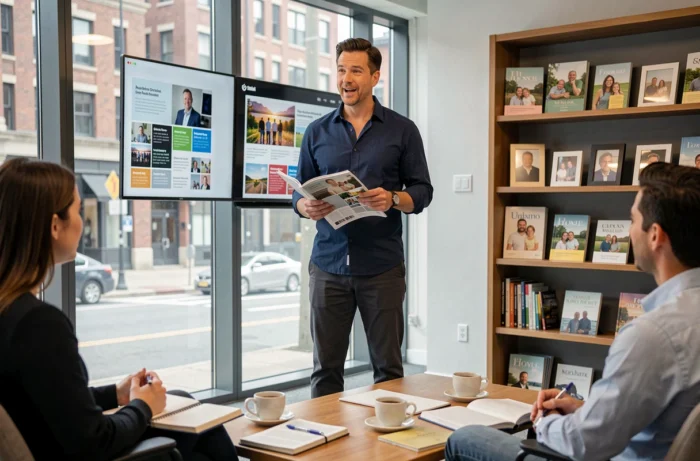
Opus Media and Family Production: When Positioning Structures the Deliverable
What sets Opus Media apart from competing structures is that the family dimension does not stop at internal culture. It directly influences the themes addressed and the formats produced.
Producing content around family (parenting, education, shared leisure, transmission) requires a particular editorial sensitivity. The tone must be right without being sentimental, informative without being condescending. Teams that themselves live in a collaborative family framework intuitively understand these nuances, whereas a traditional agency would need to rely on market studies to calibrate the gauge.
The Impact on the Advertiser Relationship
Brands targeting families seek partners capable of understanding intergenerational dynamics without caricaturing them. A production collective structured around family values produces more authentic content because its members share a common experience with the target audience.
This coherence between internal culture and external production is a competitive advantage that generalist structures cannot simply replicate by adding a “family vertical” to their offering. Editorial authenticity is built over time, not through a quarterly strategic repositioning.
The Opus Media model illustrates a fundamental trend in media production: structures that align their organizational culture with their editorial specialization produce more coherent content and better retain their clients. For advertisers in the family sector, choosing a partner that lives its values rather than merely displaying them remains the most reliable selection criterion.