
Dermatologists and dermatopathologists share a common foundation: the skin. However, their daily practices only intersect at one specific point: the glass slide placed under a microscope. Understanding the difference between these two specialists helps to position each within the care pathway and identify when one takes over from the other.
Dermatologist and Dermatopathologist: Comparative Table of the Two Specialties
| Criterion | Dermatologist | Dermatopathologist |
|---|---|---|
| Main place of practice | Office, clinic, hospital (direct consultation) | Anatomical pathology laboratory |
| Patient contact | Direct: clinical examination, questioning, follow-up | Indirect: works on samples, not on the patient |
| Central act | Clinical diagnosis, prescription, dermatological surgery | Histological reading of skin biopsies |
| Initial training | General medicine followed by specialization in dermatology and venereology | Dermatology or anatomical pathology, then subspecialization |
| Position in the care pathway | First specialized point of contact (direct access or referred by the general practitioner) | Second-line specialist, consulted by the dermatologist or surgeon |
| Pathological scope | Wide: acne, eczema, psoriasis, skin cancers, infections, aesthetic medicine | Focused on lesions requiring tissue analysis (tumors, atypical inflammatory diseases, rare diseases) |
This table outlines the main points. To better understand the difference between dermatologist and dermatopathologist, the following sections detail the most significant discrepancies between these two practices.
Clinicopathological Correlation: The Crucial Role of the Dermatopathologist in Complex Cases
The dermatologist identifies a suspicious lesion, performs or prescribes a biopsy, and then sends the sample to the laboratory. The dermatopathologist then takes over by analyzing the microscopic structure of the skin tissue.
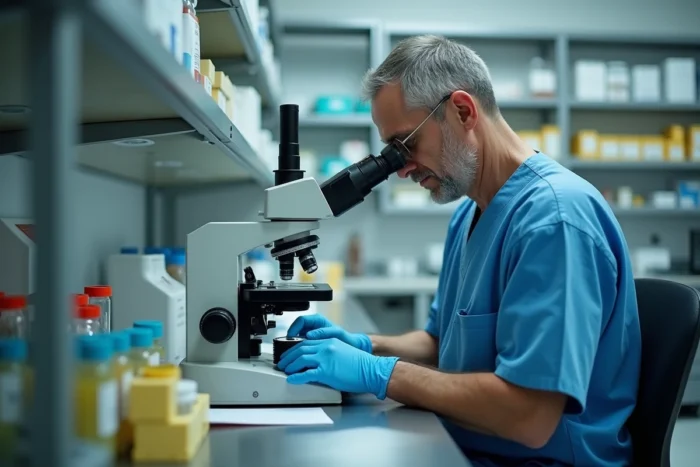
For common pathologies (wart, seborrheic keratosis, typical basal cell carcinoma), the histological reading confirms the clinical diagnosis without major difficulty. It is with rare diseases or atypical presentations that dermatopathology truly shines.
Some rare inflammatory dermatoses, certain cutaneous lymphomas, or ambiguous pigmented lesions escape detection by clinical examination alone. The dermatopathologist then correlates the clinical data provided by the dermatologist with the histological characteristics observed on the slide. This clinicopathological correlation reduces diagnostic errors that can last for several months or even years in patients with rare skin diseases.
The dermatopathologist uses complementary techniques (immunohistochemistry, special stains) to refine their interpretation. Their report directly influences the therapeutic choices of the treating dermatologist.
Training of the Dermatopathologist in France: A Subspecialty Regulated Since the 2026 Reform
The pathway to becoming a dermatologist is relatively well-known: after medical studies, the future specialist undergoes a residency in dermatology and venereology. The training of the dermatopathologist is less documented in public content.
Dermatopathology is not an autonomous specialty. It is a subspecialty accessible through two pathways: either from dermatology or from anatomical and cytological pathology. The practitioner acquires cross-competence between tissue analysis and clinical knowledge of skin diseases.
The French regulatory framework has recently evolved. A decree published in 2026 restructures the rights of practice for medical subspecialties, repealing decree no. 2012-637 of May 3, 2012. This text now regulates the extension of practice rights in non-qualifying areas, which directly concerns dermatopathologists trained in dermatology or anatomical pathology seeking official recognition of their subspecialty.
This regulatory evolution means that dermatopathology benefits from a more structured legal framework than before for the recognition of acquired competencies.
Care Pathway: When the Dermatologist Refers to the Dermatopathologist
The dermatologist remains the entry point for the patient. They can be consulted directly or referred by the general practitioner. Their daily activities combine visual diagnosis, dermoscopy, medication prescriptions, dermatological surgery procedures, and long-term follow-up of chronic pathologies.

The dermatopathologist, on the other hand, never intervenes as a first line. They receive samples, not patients. Their involvement occurs in specific situations:
- A skin biopsy performed to confirm or rule out a suspicion of malignant tumor (melanoma, squamous cell carcinoma, cutaneous lymphoma)
- A sample taken in the face of an inflammatory dermatosis that resists treatment or has an unusual clinical presentation
- A request for a review of slides when a first standard anatomical pathology examination has not resolved the diagnosis
This second-line position explains why the dermatopathologist remains less visible to the general public. The patient usually has no direct contact with this specialist, although their analysis often determines the course of care.
Complementarity Rather Than Hierarchy
The relationship between these two specialists functions in a loop: the dermatologist provides clinical information and the sample, the dermatopathologist returns a histological diagnosis, and the dermatologist adjusts the treatment. The most complex cases lead to multidisciplinary consultation meetings where both areas of expertise confront each other directly.
A diagnosis of a rare skin disease made without dermatopathological examination remains fragile. Conversely, a histological reading without precise clinical context loses reliability. Each specialist depends on the other for non-trivial cases.
The choice between consulting a dermatologist or seeking the opinion of a dermatopathologist does not arise for the patient themselves. It is the dermatologist who decides, based on the complexity of the case, to call upon this microscopic expertise. This referral mechanism, invisible in the classic care pathway, remains a crucial link in the quality of diagnostic dermatology.