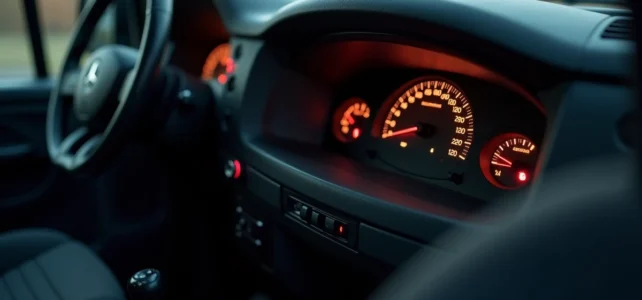
On the Mercedes Vito W447, the dashboard consolidates alerts that pertain to distinct functional families: engine mechanics, active safety (ADAS), electrical management, and pollution control systems. Confusing an ESP warning related to a faulty wheel sensor with a pure engine alert leads to erroneous diagnostics and unnecessary interventions. Here, we detail the technical points that general guides do not address.
ADAS and Active Safety Alerts on the Vito: Regulatory Alerts, Not Options
New vehicles registered in Europe since July 2022 include Intelligent Speed Adaptation (ISA). This requirement has been extended to all new vehicles put into circulation from July 2024. On a recent Vito, a speed-related warning may pertain to a mandatory regulatory system, not a Mercedes option that could be ignored.
Mercedes now distinguishes active safety alerts from classic engine alerts in its recent manuals. A warning light may relate to autonomous emergency braking, driver attention monitoring, or traction control, without any mechanical fault being involved. An orange symbol representing a coffee cup, for example, indicates inattention detected by the Attention Assist system, and not an anomaly in the powertrain.
We recommend consulting the meaning of the dashboard warning lights on the Mercedes Vito to quickly identify whether the alert concerns ADAS or mechanics, as the response to adopt differs radically between the two cases.
An orange ADAS warning generally does not require immediate stopping, but it signals that the active safety system is disabled or degraded. Driving without functional emergency braking on a loaded utility vehicle significantly alters the stopping distance.

ESP and ASR Electronic Faults on the Mercedes Vito: OBD Diagnosis
The battery, wheel sensors, and wiring remain the most common causes of ESP and ASR warning lights on the Vito. Before suspecting an expensive ECU or hydraulic block, we systematically check these three elements.
ABS Wheel Sensors and Wiring
A dirty wheel sensor or a damaged cable is enough to simultaneously trigger the ESP, ASR, and ABS warning lights. The Vito W447, used in professional conditions (construction sites, urban deliveries), exposes its sensors to repeated splashes and shocks. OBD diagnosis remains the most reliable method to identify which sensor is sending an aberrant signal.
Reading the fault codes via an OBD tool compatible with Mercedes (KWP2000 or UDS protocol depending on the generation) allows isolating the faulty sensor without preventive disassembly. For example, a code C1049 points to the rear right sensor, while a C1045 concerns the front left.
Voltage Drop and False Faults
A weak battery generates ghost alerts across multiple systems simultaneously. When the dashboard displays ESP, airbag, and injection at the same time, the reflex is to check the battery voltage before any other intervention. On the Vito, a voltage below the nominal threshold at startup triggers a cascade of warning lights unrelated to a real fault.
- Check the battery voltage when cold (before starting) and after starting: an abnormal discrepancy points to the alternator or the battery itself
- Inspect the terminals and chassis ground, as a poor electrical connection is enough to disrupt the CAN network
- Read the OBD fault codes in chronological sequence to distinguish the root cause from secondary faults triggered in cascade
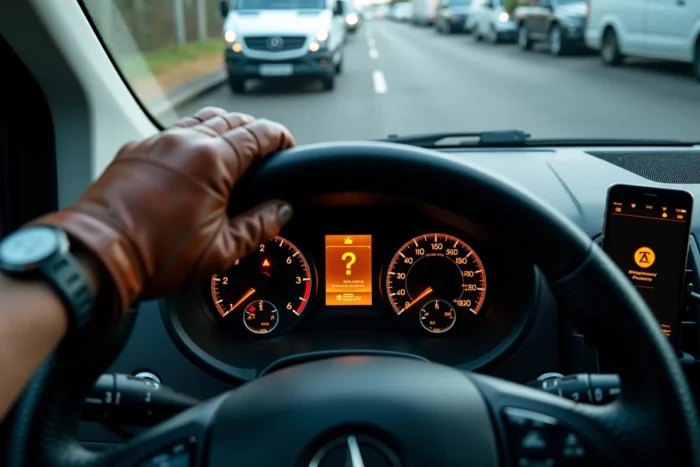
Orange Engine Warning Light and AdBlue System on the Diesel Vito
The orange engine warning light (MIL) on the diesel Vito covers a wide spectrum, from a simple minor emissions fault to a turbo failure. We observe that on the OM651 and OM654 engines equipping the Vito, the AdBlue system is the primary source of the engine warning light after a few years of use.
The ECU continuously monitors the quality of the SCR catalytic reduction. A faulty NOx sensor, a clogged AdBlue injector, or simply a low fluid level triggers an orange alert accompanied by a text message on the display. If the fault is not corrected, the system imposes a power limitation, followed by a starting block after a defined number of ignition cycles.
Reset Dial Trap
Attempting to reset the engine warning light via the instrument cluster dial does not erase the fault code in the ECU. The light may temporarily turn off without resolving the issue. The code remains stored and will reappear, sometimes accompanied by a switch to a more restrictive degraded mode.
The best practice is to read the OBD fault code, correct the cause (AdBlue refill, NOx sensor replacement, or SCR injector cleaning), and then clear the codes using the diagnostic tool. On the Vito, a simple generic OBD reader is not always sufficient: some SCR codes require a tool compatible with the Mercedes Star Diagnostics protocol or an equivalent.
Red Warning Light on Mercedes Vito: Alerts That Require Immediate Stopping
A red warning light is non-negotiable. On the Vito, three red alerts justify engine shutdown as soon as possible:
- Engine oil pressure (symbol of an oil can): continuing to drive risks causing engine seizure within minutes. Turn off the ignition, check the level, and do not restart if the light persists after topping up
- Coolant temperature (thermometer in water): indicates overheating that could damage the cylinder head. Stop the vehicle, let it cool down, check the fluid level and the condition of the system
- Braking system (circle with an exclamation mark): may indicate insufficient brake fluid level or a hydraulic failure. Do not continue driving without verification
On a utility vehicle like the Vito, often loaded to its maximum capacity, thermal and mechanical stresses are higher than in passenger car use. Ignoring a red warning light for a few kilometers of delivery can turn a modest repair into a complete engine replacement.
The hierarchy of alerts on the Vito follows a coherent logic: red requires stopping, orange allows for a short trip to the workshop, and green or blue lights simply confirm the activation of a function. Knowing how to sort these levels of severity avoids unnecessary panic as well as costly negligence.