
The tax differential between France and Spain on manufactured tobacco remains significant in 2026, but recent tariff adjustments on the Spanish side and the French customs framework are reducing the net advantage faster than simplistic comparisons suggest. We take stock of what has changed, what remains, and what it actually costs to bring a carton back from the other side of the Pyrenees.
Spanish tariff increases of July 2026: what the official tables show
The Comisionado para el Mercado de Tabacos, attached to the Spanish Ministry of Finance (Hacienda), has published new tariff tables that came into effect in July 2026 for the peninsula and the Balearic Islands. These revisions affect the main brands of blonde cigarettes and rolling tobacco.
Premium brands like Marlboro and Camel have seen their prices per pack adjusted upwards for the second time since the beginning of 2026. Rolling tobacco in the 30 g format follows the same trajectory, with variations depending on the manufacturers.
This rate of increase is not insignificant. The Spanish government has simultaneously approved a major reform of its anti-tobacco law, which provides for a gradual tightening of taxation on tobacco products. The stated goal is to progressively align the Spanish tax burden with the European average. The price gap with France is structurally narrowing, although it remains substantial in the short term.
For French smokers checking the prices of cigarettes in Spain 2026, the trend is clear: each new tariff table chips away a few cents from the savings per pack, and these cents add up on a carton.
Canaries, peninsula, and Balearic Islands: different prices depending on the Spanish territory
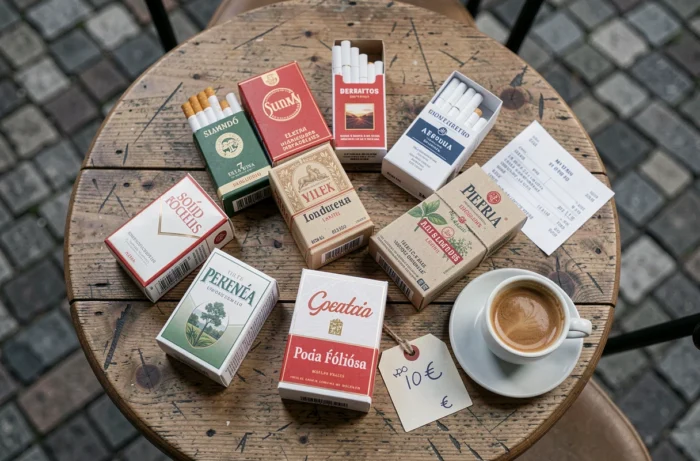
A technical point that public comparisons almost systematically overlook: prices in estancos are not uniform across the Spanish territory. The Iberian Peninsula and the Balearic Islands share the same tariff table set by Hacienda. The Canaries, on the other hand, benefit from a distinct tax regime (IGIC instead of VAT, plus reduced excise duties) that maintains significantly lower prices.
This difference creates frequent confusion. The lowest prices found online sometimes correspond to the Canaries, while the vast majority of cross-border buyers go to La Jonquera, Perthus, or Dantxaria, where the prices are those of the peninsula.
Key points for a typical cross-border purchase:
- The estancos in the Pyrenean border area apply peninsula tariffs, identical to those in Madrid or Barcelona.
- The Canaries offer lower prices, but returning to mainland France from the Canaries subjects the traveler to the customs regime of non-EU fiscal territories, with a limit reduced to 200 cigarettes (one carton).
- Ceuta and Melilla follow a regime similar to that of the Canaries, with the same drastic limitation on return.
Buying in the Canaries does not provide the same customs advantage as a purchase in mainland Spain. The favorable tax regime is nullified by the reduction in the allowed transport threshold.
Customs thresholds France-Spain: the real limit of savings
The French customs framework sets an indicative threshold of 800 cigarettes per person (or four cartons) for intra-EU transport for personal use. This figure is not an absolute right: customs may request proof if they believe the quantity exceeds strictly personal use.
In practice, exceeding this threshold without being able to justify personal use exposes one to the seizure of goods and fines. We observe that checks at Pyrenean crossing points remain frequent, particularly at Perthus and on the A9 near Boulou.
What the journey actually costs
The savings per carton purchased in the border area of the peninsula remain real, but they must be weighed against travel costs. A round trip from Perpignan to La Jonquera includes fuel, possible tolls (especially on the Spanish side on the AP-7 if one exceeds the immediate border area), parking, and time spent.
For a lone smoker traveling solely for tobacco, the net savings are only significant from two cartons purchased. Below that, travel expenses can absorb half of the differential.
- Pooling the trip among several adults (each with their own threshold of 800 cigarettes) maximizes savings per person.
- Combining tobacco purchases with other products (food, Spanish fuel) makes the overall trip more profitable.
- Keeping purchase receipts from estancos is a precaution in case of customs checks on the return.

Rolling tobacco 30 g in Spain: an even more marked differential
The rolling tobacco segment maintains a proportionally larger price gap than that of manufactured cigarettes. 30 g pouches in mainland Spain are still sold at a price that represents a fraction of the French price, even after the increases of 2026.
This higher differential is explained by the tax structure: in France, rolling tobacco has undergone targeted increases in recent years to reduce the substitution effect that smokers were making by switching from traditional cigarettes to roll-your-own. Spain has not applied the same accelerated catch-up logic to this segment.
Rolling tobacco remains the product where cross-border savings are the most tangible in 2026. For roll-your-own smokers, a visit to a border estanco retains a net economic interest, even for a short individual trip.
However, the ongoing Spanish anti-tobacco reform could change this situation in the medium term. The text provides for a gradual alignment of taxation on rolling tobacco with that of traditional cigarettes, which would reduce this specific advantage in the coming years. Keeping track of updates to the tables published by Hacienda remains the only reliable way to anticipate the actual evolution of tariffs.